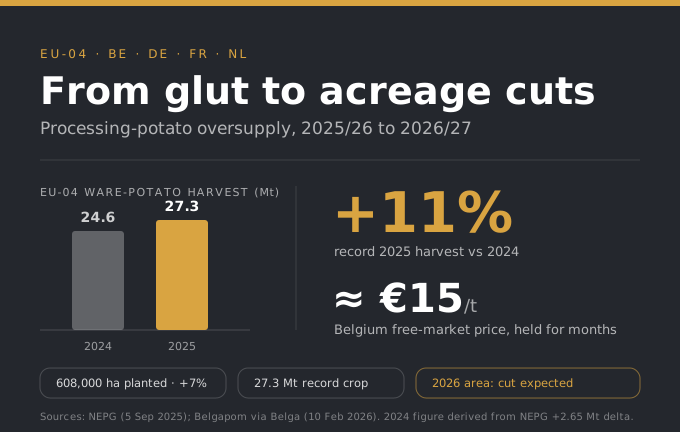
North-western Europe's main processing-potato region has flipped from years of shortage to clear oversupply. The NEPG's four-country EU-04 zone — Belgium, Germany, France and the Netherlands — planted 608,000 hectares in 2025 and brought in a record crop. The NEPG's September forecast, based on trial digs, put the EU-04 consumption-potato harvest at about 27.3 million tonnes, roughly 11% above 2024; by early 2026 it described total harvested volumes across the four countries as nearing 30 million tonnes. With processor demand softening at the same time, uncontracted potatoes collapsed to feed-grade prices, and growers' organisations now expect a meaningful cut in planted area for the 2026/27 campaign.
- 608,000 ha
- EU-04 area planted, 2025 (+7%)
- +11%
- 2025 harvest vs 2024 (+2.65 Mt, forecast)
- ≈ €15/t
- Belgium free-market price (early Feb 2026)
- −25%
- France 2026/27 contract prices
01 · From shortage to glut
After several seasons of tight supply and strong prices, growers across the EU-04 expanded plantings hard. The NEPG noted that 2024 area was already up 7% (about 37,000 extra hectares), and that spring 2025 added nearly 40,000 hectares more, lifting the four-country total to 608,000 hectares — another 7% year on year. The organisation attributed the build-up to two seasons of signals about rising processor demand and new processing capacity, higher contract prices, and potatoes looking profitable against competing crops.
02 · A record crop the market can't absorb
Based on trial digs across the zone, the NEPG forecast a record harvest of around 27.3 million tonnes — 2.65 million tonnes, or 11%, above 2024. The problem was timing: the extra volume landed as demand cooled. The NEPG said a significant share of the crop could not be stored, and tens of thousands of tonnes were redirected to animal feed, biogas plants or composting rather than the food chain.
03 · Prices at the floor
The price signal was stark. In early February 2026, the Belgian trade-and-processing body Belgapom reported that growers were receiving roughly €15 per tonne on the free market — a level that had held for months — with its chief executive expecting further falls. Belgapom noted that 70–80% of the harvest had been pre-sold under contract at higher fixed prices agreed months earlier, so it was the uncontracted potatoes — destined mainly for large fry producers — that faced rock-bottom quotes.
France showed the same squeeze working through the contract book. In early 2026, the national producers' association UNPT reported a decline in the number of contracts on offer for the 2026/27 campaign and an approximately 25% cut in contract prices, with the reference price for the industrial Fontane variety put around €130 per tonne, down from about €180 a year earlier.
Takeaway: the surplus is concentrated in factory potatoes, not table varieties — so it bites processors' raw-material costs and growers' margins, not supermarket shelf prices.
04 · Why demand softened
The supply story explains only half the swing; demand is the other half. The NEPG attributed weaker processor offtake to US tariffs weighing on frozen-fry exports, a strong euro against the dollar that erodes European competitiveness, and intensifying competition from producers in China, India, Egypt and Turkey. The capacity map was shifting alongside it: Belgian processor Agristo is investing €80 million in a new frozen-fry line in India, while in October 2025 US group Simplot completed its acquisition of Belgian frozen-fry specialist Clarebout and its five plants — new volume increasingly going up in lower-cost regions, and even heartland assets passing into global hands.
05 · The 2026/27 turn
With production costs unlikely to fall and many farms set to book losses on the 2025 crop, the NEPG urged a significant reduction in EU-04 planted area for 2026 — stressing the extent would hinge on how processors contract. Its framing was pointed: 2025 was a supply crisis that could become a demand crisis in 2026 if growers lost the economic capacity to keep producing. The body urged more continuous dialogue across the chain so that area is matched to demand rather than running ahead of it. As of mid-2026, with planting complete, official EU-04 area figures for 2026 were still pending; growers' bodies had signalled lower area, but views differed on whether the cut would be large enough to rebalance the market.
EU-04 at a glance
| Metric | 2025 (EU-04) | Change vs 2024 | | --- | --- | --- | | Planted area | 608,000 ha | +7% (≈ +40,000 ha) | | Harvest (NEPG Sept forecast) | ≈ 27.3 Mt | +11% (+2.65 Mt) | | Belgium free-market price (early Feb 2026) | ≈ €15 / t | multi-month low | | France Fontane contract (2026) | ≈ €130 / t | from ≈ €180 / t | | 2026 planted area | — | lower area expected; figure pending |
Data: NEPG (5 Sep 2025); Belgapom via Belga News Agency (10 Feb 2026); UNPT via AFP / France 24 (10 Feb 2026); Simplot (31 Oct 2025). EU-04 = Belgium, Germany, France, the Netherlands. The 2025 harvest concluded in autumn 2025; 27.3 Mt was the NEPG's September trial-dig forecast for consumption potatoes, while by early 2026 the NEPG put total 2025 harvested volumes across the four countries nearer 30 Mt. The 2026 area direction is the sector's stated expectation; no official figure was available at publication.
Why it matters for the industry
For processors, a glut of cheap free-buy potatoes is a near-term margin tailwind — but the binding constraint is demand, not supply, and tariffs, a strong euro and lower-cost Asian and North African competitors are all working against European export volumes. For growers, feed-grade prices on food-grade crops, thinner contract books and a 25% cut in offered prices made another year of expansion uneconomic, which is why the sector has signalled lower area for 2026/27. The risk that the chain knows well is the cycle itself: a sharp acreage cut to clear today's surplus can set up tomorrow's shortage, so the 2026 planting outcome — and how processors contract against it — is the variable to watch.
