The registration
What Solynta listed
SOLHY019 is a diploid hybrid potato variety propagated from true seed rather than seed tubers. Solynta says the listing carries an accompanying breeder's right and treats the approval as evidence that its hybrid breeding platform meets the standards required for international market access.
National listing is the regulatory gateway to the wider EU market: once a variety is admitted to a member state's national catalogue it can be traded across the Union and is notified to the EU Common Catalogue. Dutch listings for agricultural varieties run for ten years before renewal, and the examination behind registration and breeder's rights is conducted by Naktuinbouw's variety-testing department on behalf of the Board for Plant Varieties.
Context
Why it counts as a first
Solynta's earlier approvals were secured outside the EU. The clearest prior milestone is Kenya, where the Kenya Plant Health Inspectorate Service (KEPHIS) cleared three varieties — SOLHY007, SOLHY012 and SOLHY015 — for commercial release in 2024. The company had publicly flagged its initial EU market entry for 2026, pending regulatory approval, while running field trials and commercial groundwork across more than 40 countries. The Dutch listing is the first concrete step of that EU entry.
| Milestone | When | What happened |
|---|---|---|
| Kenya commercial release | Jul 2024 | KEPHIS clears SOLHY007, SOLHY012 and SOLHY015 for sale |
| EU entry signalled | 2025 | Solynta flags initial EU market entry for 2026, pending approval |
| Dutch national listing | 11 Jun 2026 | SOLHY019 listed — first HTPS variety in the Netherlands, first EU registration |
The economics
The case for true seed
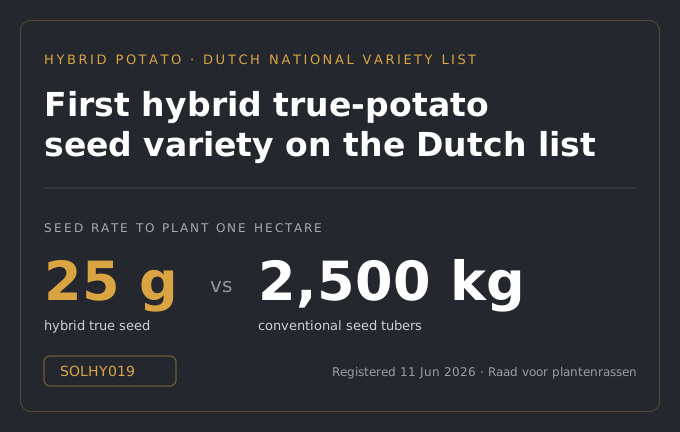
The commercial argument for hybrid true potato seed rests on replacing bulky seed tubers with a small quantity of true seed. Solynta puts the planting rate at roughly 25 grams of seed per hectare, against about 2,500 kilograms of seed tubers to cover the same area. The company says true seed is disease-free, stores for years, ships cheaply and is available year-round — addressing the clean-starting-material shortages that constrain growers in many markets.
Solynta also states that hybrid breeding lets it stack natural traits such as late-blight resistance, lowering crop-protection inputs. Those trait claims are company-stated and specific to individual varieties.
The core argument
Why it matters for the industry
For the processing and frozen-fry supply chain, the weight of this listing is less the single variety than what regulated EU availability of true-seed propagation could change downstream. True seed promises more uniform crops and tighter phytosanitary control, and Solynta's breeding work with Averis Seeds — a subsidiary of starch cooperative Royal Avebe — is aimed specifically at processing-grade material. Over time, disease-resistant seed-based varieties could reshape how processing potatoes are bred, multiplied and supplied. That outcome still depends on commercial-scale rollout, processor acceptance and agronomic performance in EU conditions — none of which a single national listing settles.
Establishes
- A national listing makes SOLHY019 legally tradeable in the EU and eligible for the Common Catalogue.
Doesn't establish
- Evidence of commercial availability at volume — Solynta describes its European entry as a phased approach built on trials, partnerships and regulatory alignment.
- Independent, EU-condition yield and quality data for the variety, which are not yet in the public record.
- A portfolio — the listing covers one variety rather than a range.
