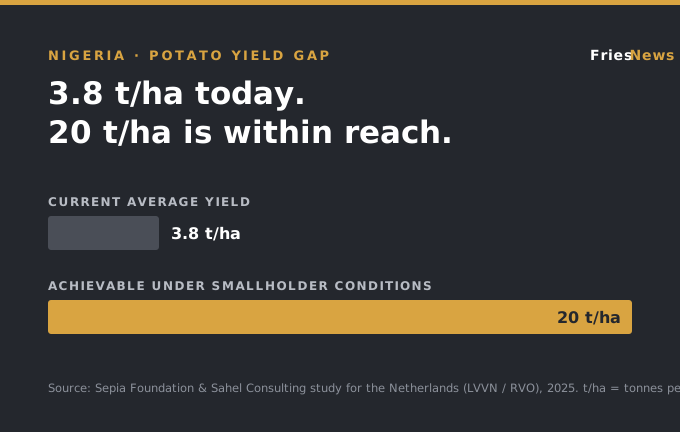
Nigeria's Jos Plateau holds the largest contiguous potato-growing area in sub-Saharan Africa, yet the country is only the region's fourth-largest producer by volume — and it imports most of the frozen fries it eats. The reason isn't a shortage of land. It's a value chain that stalls at the very first link: farmers replant virus-infected informal seed, average yields sit near 3.8 tonnes per hectare against roughly 20 that smallholders could reach, and the harvest that does come in has nowhere to be stored. Very little reaches a processor in the consistent, processing-grade form a fries or flake line needs.
The land is there. The output isn't.
The cool highlands of Plateau State have grown potatoes since missionaries introduced the crop in the 19th century, and the Jos Plateau is now described as the largest single block of potato land in sub-Saharan Africa. But "largest growing area" is not the same as "largest producer." By harvested volume, Nigeria ranks only fourth in sub-Saharan Africa, well behind commercial, high-yield South Africa.
That gap between footprint and output is the whole story. A 2025 study carried out by the Sepia Foundation and Sahel Consulting — commissioned by the Netherlands' Ministry of Agriculture (LVVN) and Enterprise Agency (RVO) — puts Nigeria at over 320,000 hectares under potato and around 1.2 million tonnes a year, for an average yield barely above 3.8 tonnes per hectare. The same study notes that roughly 20 tonnes per hectare is achievable under ordinary smallholder conditions. In other words, the plateau is farming a European-scale land area at a fraction of European productivity.
(Older figures of 843,000 tonnes on about 270,000 hectares at 3.1 t/ha still circulate widely. Those trace to FAO data from around 2007 and should not be presented as current.)
The bottleneck is seed
The single biggest constraint is the quality of what farmers plant. The Sepia–Sahel study surveyed 97 farmers and interviewed stakeholders across the value chain, and the findings point in one direction:
- Most farmers buy seed from informal open markets — small, visually selected tubers that are frequently carrying viruses and produce weak crops.
- More than 86 percent of farmers surveyed named late blight as their biggest production problem, despite heavy fungicide use — a sign of poor application, substandard product, or both.
- Nearly half renew their seed only every three years or longer, with little awareness of how quickly seed degenerates.
The result is a lock-in. Low awareness depresses demand for certified seed, which keeps the market too thin for local or international seed companies to serve profitably, which keeps quality seed scarce — and yields low. Breaking that loop is the precondition for everything downstream.
The study sketches four routes out, in rising order of ambition: a lead local enterprise importing and multiplying certified seed; decentralised small-scale multipliers working from imported certified stock; local multiplication from apical rooted cuttings (in pilot with the International Potato Center and Fruits & Veggies); and, most disruptively, true potato seed multiplied locally. Across all four models, the study estimates a retail seed cost of roughly N650 to N1,480 per kilogram — a competitive range if paired with farmer education on the return that better seed delivers.
No storage means no leverage
Even when the harvest is good, the plateau cannot hold it. The shortcoming showed up starkly in 2025: by late August, Daily Trust and regional market trackers reported Jos Plateau bag prices collapsing to roughly a fifth of their earlier highs as a strong harvest hit a market with nowhere to put it. Without storage, farmers must sell into the glut at a loss or push tubers across the border into Niger, Chad and Ghana — the cross-border trade that gives the "feeds the neighbours" claim its grain of truth.
For a processor, that volatility is disqualifying. A fries or flake plant needs steady, year-round supply at a known quality and dry-matter content. A crop that swings from scarcity to fire-sale glut within a season, with no cold or ambient storage to smooth it, cannot underwrite an industrial offtake contract.
The processing gap — and the import bill
Demand is not the problem. Nigeria's quick-service restaurants, hotels, supermarkets and a growing urban middle class consume fries and chips in volume, and a meaningful share of the frozen product is imported — historically from Belgium, the Netherlands and South Africa. The structural picture is consistent across trade accounts: import dependence persists because domestic processing-grade supply is unreliable, not because Nigerians won't buy local. Trade data illustrates the dependence directly: in 2024 Nigeria imported roughly 960 tonnes of frozen potatoes from China alone (about US$0.78 million), per UN Comtrade.
The constraints that block local processing are the same ones that depress yield: scarce processing-grade seed with adequate dry matter, post-harvest losses from absent storage, and high energy and cold-chain costs that make industrial freezing and frying expensive. The opportunity is equally clear — as the naira makes imports dearer and the African Continental Free Trade Area opens regional export lanes, a reliable domestic crop would have a ready market. The Sepia–Sahel work frames seed-system renewal explicitly as the lever that could "support the growth of a domestic potato processing industry."
What it would take
The sequence is not mysterious. Clean seed lifts yield; higher and more predictable yield, paired with even basic storage, makes consistent volume possible; consistent volume of the right variety makes a processor bankable. The enabling environment has to move in parallel: regulatory clarity on seed import and certification, plant variety protection, enforcement against adulterated "certified" brands, and farmer training on seed degeneration and disease control.
The Jos Plateau already has the rarest input — the land and climate to grow potatoes at scale in West Africa. What it lacks is the first link in the chain. Until clean seed and storage are solved, sub-Saharan Africa's largest potato-growing area will keep growing a large, low-value crop while the country's fries arrive frozen, from somewhere else.
Data notes & sources
- Largest contiguous potato-growing area in sub-Saharan Africa — attributed to Gildemacher (2025), via the Sepia–Sahel study. Verify against the Gildemacher primary before treating as settled fact.
- Fourth-largest producer in sub-Saharan Africa by volume — FAO.
- ~320,000 ha · ~1.2 million tonnes · ~3.8 t/ha current · ~20 t/ha achievable; seed-system survey findings; four seed models; N650–N1,480/kg — Sepia Foundation & Sahel Consulting study for the Netherlands' LVVN and RVO, published July 2025.
- 843,000 t / ~270,000 ha / 3.1 t/ha — FAO, c. 2007 (International Year of the Potato era). Dated baseline; not current.
- 2025 price crash / storage gap; cross-border trade to Niger, Chad, Ghana — Daily Trust and regional market reporting, August–September 2025.
- Import dependence on Belgium, Netherlands, South Africa; QSR/retail demand — trade and market accounts; treat as attributed structural estimate pending a primary trade-data confirmation.
