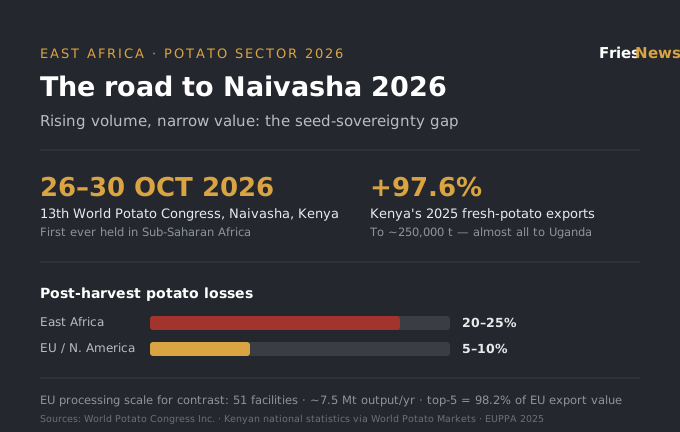
The world's potato industry will, for the first time in its more-than-thirty-year history, hold its flagship gathering in Sub-Saharan Africa. The 13th World Potato Congress runs at Naivasha, Kenya, from 26 to 30 October 2026 — a symbolic marker for a region that grows potatoes in growing volume but captures little of the value that flows from them.
East Africa's potato story in 2026 is one of fast-rising production and exports set against a stubborn structural gap: the continent's growers sit at the low-margin, fresh-and-regional end of a chain whose high-margin tiers — seed genetics, industrial processing, branded retail — remain concentrated in Europe and North America. The defining questions for the East African Community (EAC) are not about whether it can grow more potatoes. They are about seed sovereignty, value addition and who sets the rules.
1. Why Naivasha 2026 matters
The World Potato Congress is the global sector's periodic gathering of breeders, traders, processors, regulators and scientists, rotating across continents. Until 2026 it had never been hosted in Sub-Saharan Africa. The Naivasha edition — at Sawela Lodges on the shores of Lake Naivasha in Kenya's Great Rift Valley — is hosted by the National Potato Council of Kenya (NPCK) and FreshCrop Limited, and is expected to draw more than 1,000 delegates from over 60 countries alongside 1,500-plus local farmers, under the theme "Global Potato Partnership for Enhanced Food Systems, Nutrition Security and Trade."
The hosting is not purely ceremonial. It places African production realities — equatorial double-cropping, smallholder seed systems, disease pressure under climate variability — onto the global research agenda, and it gives East African breeders, regulators and processors a rare chance to negotiate with Dutch seed houses, North American processors and Andean germplasm holders closer to home turf. The Congress moved to Kenya after the previously scheduled Gdansk, Poland event was cancelled.
2. The export surge — real, but narrow
Kenya's recent trade numbers represent a genuine inflection. National statistics show that in 2025 the country exported almost 250,000 tonnes of fresh potatoes, up 97.6% on 2024 and a record. Seed-potato exports jumped too, from 128 tonnes in 2024 to 1,125 tonnes in 2025.
Two caveats keep this in proportion, and both matter for anyone reading the headline growth figure as a sign of arrival in the global value chain. First, the trade is overwhelmingly fresh and overwhelmingly regional: Uganda absorbed almost all of it, with small volumes to South Sudan and Somalia. An export base resting on a single neighbour is structurally fragile. Second, fresh potatoes earn a fraction of what processed exports do — the average Kenyan fresh-potato export price in 2025 was about US$313 per tonne, an order of magnitude below the value commanded by frozen, processed product. The surge is real; it is not yet a move up the value chain.
3. Varietal sovereignty: Shangi versus the industrial standard
To understand the political economy of the potato, follow the variety. The contrast between the industrial varieties of the Global North and East Africa's locally-evolved landscape exposes the central tension: who decides what farmers plant?
In North America and Europe, the dominant processing varieties — Russet Burbank, Innovator, Fontane — were bred for industrial uniformity: long dormancy, mechanical harvesting, defined fry shape, low reducing sugars. They also take roughly 110 to 150 days to mature, a real constraint for smallholders on shorter, climate-variable cycles.
East Africa's market tells a different story, dominated by Shangi — a variety that occupies the overwhelming majority of Kenya's production area and was never bred to a formal industrial target profile at all. Its defining feature was originally classified as a defect: very short tuber dormancy, with maturity in roughly 75 to 90 days. What breeders treated as a weakness, smallholders, women-led cottage processors and traders treated as a strength. Short dormancy and early maturity suit year-round production in a market with little cold storage and unreliable seed systems — giving farmers continuous access to planting material and processors a steady supply. Shangi's rise outside any formal release process is a quiet rebuke to the assumption that Northern breeding pipelines automatically produce the right varieties for Southern conditions.
Alongside Shangi, a wave of climate-resilient varieties developed through partnerships between the CGIAR-affiliated International Potato Center (CIP) and national research institutes is reshaping the landscape — bred for heat tolerance, disease resistance and shorter cycles. But adoption lags badly. A peer-reviewed 2020 study in Meru County, Kenya, found the actual adoption rate of climate-resilient varieties was just 6.3%, against a potential of 30.7% given full access to information and quality seed. That five-fold gap is among the sharpest measures of why East African potato productivity remains far below its biological potential.
4. The seed-sovereignty question
The genetics at the top of the chain are consolidating. In February 2026, Royal HZPC Group — the world's largest seed-potato supplier, exporting to more than 90 countries — finalised its acquisition of Ireland's IPM Potato Group, the market leader in Irish seed-potato breeding and the largest exporter of protected varieties from the United Kingdom. The deal, first announced in October 2025, adds roughly 1,800 hectares to HZPC's acreage, primarily in Scotland, and HZPC explicitly identified North Africa as a growth region for the combined business. IPM retains its name and management, and its 50-year research partnership with Teagasc, Ireland's national agri-food research institute, moves into the enlarged group.
For African strategists the implication is structural rather than immediate: even where "European seed" arrives in different markets under different brand names, the breeding pipeline behind those varieties is increasingly concentrated. That backdrop sharpens an active regional debate. The EAC is navigating a Seed and Plant Varieties Bill intended to harmonise certification and ease cross-border seed movement — aligned with continental and free-trade frameworks. It has met significant resistance from smallholder-farmer groups and civil society, who argue that alignment with international plant-breeders'-rights conventions could constrain farmers' traditional rights to save, exchange and sell seed, and could let private breeders assert intellectual property over varieties partly derived from public germplasm or, as with Shangi, from informal farmer selection. Proponents counter that harmonisation is essential to attract investment and reduce import dependence. The resolution of that tension — more than any single technical reform — will shape whose interests the next generation of EAC seed policy serves.
5. Master plans and corridors
What is emerging across the region in 2026 is, in effect, an integrated regional strategy assembled from national parts.
In Kenya, the NPCK — with CIP and other partners — is finalising a 10-year Potato Industry Master Plan (2026–2035), aimed at certified-seed multiplication, processing-grade variety development, value addition (chips, frozen fries, starch, flour, flakes) and stronger coordination across counties. The dysfunctional formal seed system is the binding constraint it must address: certified seed supplies only a small share of national demand, with informal recycling accounting for the overwhelming majority — a primary reason national yields sit well below potential.
In Tanzania, the potato sector is folded into a broader corridor strategy. The country's long-running Southern Agricultural Growth Corridor framework — credited with lifting smallholder potato yields several-fold in the Southern Highlands of Iringa, Njombe and Mbeya, which account for the bulk of national output — has been succeeded by a nationwide Agricultural Growth Corridors of Tanzania (AGCOT) framework. The establishment of a Potato Council of Tanzania in 2024 adds organised industry support for seed quality, soil health and market access.
These national vehicles increasingly operate inside a continental envelope — the African Union's latest decade-long agrifood strategy, which sets targets for mobilising investment, lifting output, expanding intra-African trade and halving post-harvest losses. For the potato sector, that last target depends directly on the cold-chain and value-addition investments the region most conspicuously lacks.
6. The value-addition gap
The clearest measure of the distance between East Africa and the established processing economies is what happens to the crop after harvest. In Europe and North America, integrated cold chains, mechanical handling and contract-grower systems hold post-harvest potato losses to roughly 5 to 10%. In East Africa, poor storage, rough handling and high temperatures push losses to around 20 to 25%.
The contrast in processing scale is starker still. Europe's processing industry, represented by EUPPA, runs 51 industrial facilities producing around 7.5 million tonnes of frozen fries and other potato products a year, on turnover of about €9.8 billion — and that output is intensely concentrated, with the top five EU exporters (Belgium, France, Germany, the Netherlands and Poland) accounting for 98.2% of EU27 export value. East Africa, by contrast, has a thin layer of industrial-scale processors sitting above a much larger universe of small, largely women-led cottage operations working without certified-seed contracts, formal cold storage or branded retail distribution.
The economic consequence is distributional: an East African potato grower typically captures only a small share of the final consumer value of the crop, with the balance accruing to processing, branded retail and food service located elsewhere. Closing that gap — through distributed cold-chain infrastructure tied to farmer cooperatives, deliberate value-addition policy, and seed reform that protects rather than erodes farmer-managed systems — is the work that will determine whether the region's production growth translates into captured value.
7. The open question
The story of East Africa's potato sector in 2026 is one of three tensions: between volume and value, between formal and informal seed systems, and between continental ambition and corridor-level execution. Production is rising faster than the global average, but value still sits in a processing economy that relies on Andean germplasm, Dutch genetics and North American capital. Naivasha 2026 will not resolve these tensions — but it will, for the first time, force them onto a stage where Sub-Saharan Africa is host rather than guest.
Whether that moment accelerates African seed sovereignty and value capture, or simply raises the region's visibility while the margins continue to flow north, is the open question of the decade for one of the world's most strategically important food crops.
