The boom
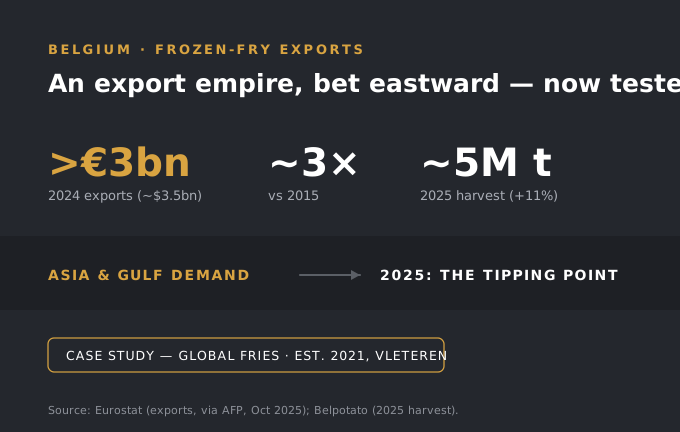
Belgium is the world's largest exporter of frozen fries, and the striking thing about that lead is how little of it the country eats. The engine is foreign demand. Cooked and frozen potato-product exports passed €3 billion — roughly $3.5 billion — in 2024, about three times their 2015 level, according to Eurostat trade data reported by AFP in October 2025.
What pulled that line upward sits well outside Europe. Christophe Vermeulen, who heads the Belgian potato-processing trade body Belgapom, frames fries as a commodity that tracks development itself: "When the population grows and the middle class grows, the demand for fries grows as well. And obviously every time something fast food-ish opens in the world, they need fries." The growth markets that description points to — fast-food expansion and a rising middle class across Asia and the Middle East — are exactly where Belgium's processors aimed a decade of added capacity.
The eastward bet, personified
Global Fries is a useful lens precisely because it is so exposed to that demand. Founded in 2021 in Vleteren, West Flanders — out of the former Barts Potato Company — it is a pure export play, and its trade-show map tells you where it is aimed: Foodex in Tokyo, Thaifex Anuga in Bangkok, FHA in Singapore, Gulfood in Dubai. That is the Asian and Gulf demand Belgapom credits for the boom, pursued by a firm barely five years old. The company says it now reaches more than 120 countries; whatever the precise figure, the direction is unmistakable — a standing start in 2021 pointed straight at the markets the boom was built on.
The squeeze
In 2025 the conditions that made the bet look easy turned. Belgium brought in a record harvest of about five million tonnes, up 11 percent on 2024, according to the sector body Belpotato — a wall of supply arriving just as the demand side softened. Pierre Lebrun, Belpotato's secretary, put it plainly: "We are at a tipping point. Global markets have been buying fewer European fries."
Three pressures arrived together. Prices slumped under the weight of the crop. A US tariff raised the cost of reaching one of the largest Western markets. And Asian producers — India, China and Egypt among them — kept scaling export-grade fry capacity, competing for the same growth buyers on price and proximity. The demand that built the boom did not vanish, but for the first time in a decade the path to it ran uphill.
What it tests
The open question is who this turn exposes most. An export-first player founded in 2021, with no large domestic base to fall back on and a book weighted toward the distant markets now under pressure, is the most exposed reading — its growth was the bet, undiluted. The opposite reading is that the same youth makes it agile: a smaller, newer exporter can re-cut its market mix and chase tenders faster than an incumbent defending legacy volume.
The data here does not settle which is right, and it would be speculation to pretend otherwise. What the figures do establish is the shape of the test. Belgium's lead was built on demand it does not consume, in regions now contested by lower-cost rivals and taxed by at least one major buyer. For the cohort of young, export-first Belgian exporters that rode the boom up, 2025 is the year that demand stops being a tailwind and starts being a question.
