The overhang
A record crop the market can't absorb
France's 2025 conservation-potato harvest reached nearly 8.5 million tonnes, up about 13% on 2024, after plantings climbed to roughly 197,000 hectares — a 15% rise in a single year and around a quarter above 2023, according to UNPT. Drawn out by years of processor demand signals and new factory capacity, that expansion has outrun the market: industry estimates put the unsold surplus at around one million tonnes.
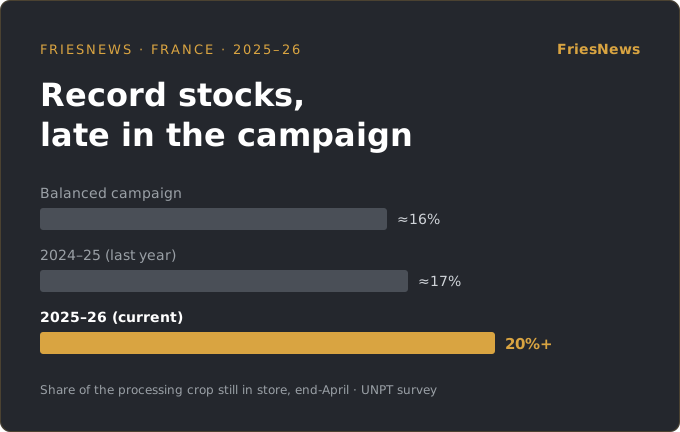
The overhang is visible in stores. UNPT's grower survey found just over 20% of the total crop still in store at the end of April — against about 17% at the same point last year and roughly 16% in a more balanced campaign. Set against a record harvest, that is the heaviest end-of-spring stock position the sector has carried in years.
| Indicator | 2025–26 | Reference |
|---|---|---|
| Conservation-potato harvest | ~8.5M t | +13% vs 2024 |
| Plantings | ~197,000 ha | +15% vs 2024 |
| Crop still in store, end-April | 20%+ | vs ~17% a year earlier |
| Contract Fontane offer (2026) | ~€130/t | vs ~€180/t in 2025 |
| Free-buy price | €0.50–4.00 / 100 kg | little buyer interest |
| Estimated surplus without outlet | ~1M t | — |
Price and contracts
Prices collapse, contracts strain
Weak demand has dragged prices down in both channels. UNPT cites contract Fontane offers for the 2026 crop at around €130 per tonne, down from €180 a year earlier, while free-buy lots have changed hands as low as €0.50 to €4.00 per 100 kilograms with little buyer interest. Appetite for free-buy processing varieties such as Fontane and Challenger has all but disappeared, leaving the growers who carried that risk the most exposed.
The strain is now reaching contracts themselves. With factory intake easing, market reporting points to some processors buying out contracted volume rather than taking delivery — a move that pushes stock risk back onto growers and adds to the unsold tonnage. UNPT has warned through the season that contract terms increasingly leave producers holding the downside when industrial demand softens.
The paradox
Factories ease — yet imports stay high
Even with stores full at home, French processing lines have leaned on imported supply. According to DCA Market Intelligence, French factory intake fell by about 19% month-on-month in May, while the volume of imported potatoes processed this season reached a seasonal record of roughly 429,000 tonnes — already ahead of the full prior-season total with two months still left in the campaign. On the same reading, season-to-date throughput is tracking within about 1% of last year, held up by a brisk processing pace through the autumn.
The structure
Why the cross-border flow persists
The pattern is less paradoxical than it appears. French and Belgian processing are tightly integrated: Belgian and Dutch factories process around 1.5 million tonnes of French potatoes a year — roughly half of France's industrial crop — and the largest French-based plants sit within reach of Belgian supply chains. Clarebout's Dunkirk factory, running since late 2023 and now part of US group J.R. Simplot after its acquisition completed in October 2025, is the clearest case: a French production site sourcing across the border from a Belgian base, one of several operators working both sides of the frontier. UN Comtrade data underline how entwined the two markets are: in 2024 France shipped well over USD 300 million of fresh potatoes to Belgium while importing roughly USD 95 million back across the border — the reverse flow that feeds plants like Dunkirk. For plants built around contracted Belgian volume, running imported potatoes can coexist with a domestic glut — the imported tonnage is locked in by contract, while unsold French free-buy lots sit outside those supply lines.
Why it matters for the industry
With two months left in the campaign, French throughput is running broadly level with last season, and a record-equalling processing total is not out of reach if intake holds. But it would be a hollow milestone in a year defined by oversupply: even near-full processing has not cleared the stores, and an estimated million tonnes may still go unsold. For growers — especially those holding free-buy Fontane and Challenger — the figures offer little comfort, and finding alternative outlets is the defining problem of the season.
