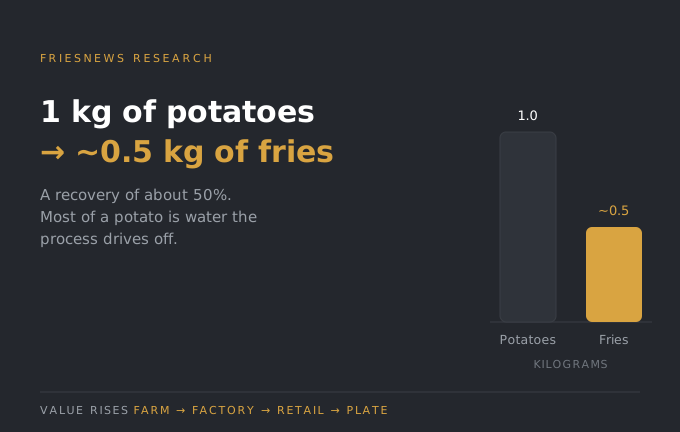
A kilo of potatoes makes about half a kilo of fries
The single most important number is recovery: how much finished product survives from the raw tuber. For frozen French fries it is about 50%. Peer-reviewed work in Potato Research puts recovery, after peeling, blanching and par-frying, at roughly half the raw weight — because fries retain about 78% of the water already present in the fresh potato. The Swiss supply-chain study by Willersinn and colleagues reaches the same point from the other direction: it takes about 1.84 kg of fresh tubers to make 1 kg of frozen fries once losses along the chain are counted.
So 1 kg of potatoes becomes roughly 0.5 kg of frozen fries. Two things move that figure. The first is dry matter: a potato is about four-fifths water, and the higher its dry-matter concentration, the more fry survives — which is why processors pay for high-solids varieties bred for the job. The second is how finished the product is. Frozen fries are only par-fried; the final fry in a restaurant or oven drives off more moisture again, so a fully cooked, ready-to-eat portion needs more raw potato still, closer to 2–3 kg per finished kilogram.
There is a neat principle underneath all of this, stated plainly in the same research: market value is inversely proportional to recovery. The more of the potato you remove — water, peel, off-cuts — the less product remains, but the more each surviving kilogram is worth. Dried products such as crisps, flour and starch recover only about a quarter of the raw weight, and fetch the highest price per kilo of all.
What the raw potato is worth
Processing potatoes are a low-value bulk commodity. Recent European benchmarks for the EU-4 processing zone (Belgium, the Netherlands, France and Germany) have sat in the order of €0.15–0.25 per kilogram — roughly €150–250 per tonne — with the exact level swinging on harvest size, variety, and whether potatoes trade on contract or on the open free-buy market (Expana Benchmark Price; grower-union figures). The European Energy Exchange runs a Processing Potato Index, averaging recognised prices across the four countries, precisely because the number moves so much.
For this calculation, treat the raw material in 1 kg of potatoes as worth roughly €0.15–0.25.
At the factory gate, the fries are worth several times the potato
Turn that kilo into about 0.5 kg of frozen fries and the value changes character. EU frozen-fry export prices have recently run around €1,200–1,250 per tonne — about €1.2 per kilogram — according to DCA Market Intelligence, broadly in line with US (about $1.68/kg) and Canadian (about $1.38/kg) exports and with emerging suppliers such as China, India and Egypt (roughly $1.00–1.40/kg).
At €1.2/kg, the 0.5 kg of fries from our single kilo of potatoes is worth about €0.60 at the factory gate. The raw potato content of that product cost somewhere around €0.08–0.13. Processing — peeling, cutting, blanching, par-frying, freezing and packing — has roughly tripled to quadrupled the value of the potato in the bag. That uplift pays for energy (frying and freezing are the most energy-intensive steps in the entire chain), labour, plant, and the convenience the buyer is really paying for.
On the way to the plate, the value multiplies again
The factory gate is only the first markup. At retail, frozen fries typically sell for somewhere around €2–3 per kilogram, so the half-kilo from our potato is worth roughly €1.00–1.50 on a supermarket shelf — illustrative, since shelf prices vary widely by market and brand.
Foodservice is where the multiplication turns dramatic. After the final fry, 0.5 kg of frozen fries yields a little over 0.4 kg of cooked fries — about three restaurant portions of roughly 140 g. At €3–4 a portion, that is on the order of €9–12 of menu value from a single kilogram of potatoes. The potato itself is a rounding error on the bill; what the diner pays for is cooking, service, rent and brand.
The value ladder, in one view
| Stage (from 1 kg of raw potatoes) | Approx. output | Approx. value | Basis |
|---|---|---|---|
| Raw potatoes, farm gate | 1 kg | €0.15–0.25 | Indicative benchmark |
| Frozen fries, factory / export gate | ~0.5 kg | ~€0.60 | Attributed estimate |
| Frozen fries, retail shelf | ~0.5 kg | ~€1.00–1.50 | Illustrative |
| Cooked fries, restaurant plate | ~3 portions | ~€9–12 | Illustrative |
Why the gap is so wide
The honest answer to "how much worth of fries can you make from a kilo of potatoes" is: anywhere from about €0.60 to more than €10, depending on how far down the chain you stop. The spread is not a pricing quirk — it is the whole logic of processed food. Most of a raw potato is water and material the process strips away; what is sold at each subsequent stage is less potato and more transformation: form, shelf life, food safety, convenience and, finally, a hot product on a plate. The cost of the potato itself barely changes from field to fryer. Almost everything else on the final bill is value added on top of it.
