China has spent the past six months turning its trade-defence machinery on European agri-food — definitive anti-dumping duties on EU pork in December, an anti-subsidy probe into EU dairy — and in April it codified its first dedicated supply-chain-security and counter-sanctions framework. For frozen-potato processors the instinctive question is whether fries are next on the list. The trade data points the other way: China barely imports fries any more, so there is almost nothing for Beijing to put a tariff on. The exposure that matters for European and American fry exporters is competitive, not tariff — a fast-scaling, state-supported Chinese fry-export industry pressing their product in shared Asian markets.
The case file: what China has actually done
The campaign against EU agri-food is concrete and recent. On pork, China's Ministry of Commerce (MOFCOM) moved from provisional security deposits in September 2025 to a final ruling on 17 December 2025, confirming dumping and imposing definitive anti-dumping duties for five years (final rates landed materially below the provisional levels). On dairy, MOFCOM opened a separate anti-subsidy investigation late in 2025, with preliminary measures at the end of December covering milk, cream, curd and several cheeses. The UK levy board AHDB frames both actions as part of widening EU–China trade tension rather than one-off cases.
Sitting behind that activity is new legal infrastructure. On 7 April 2026 the State Council published Order No. 834, Regulations on Industrial Chain and Supply Chain Security — China's first dedicated administrative regulation in this area — alongside Order No. 835 on countering improper foreign extraterritorial jurisdiction. Order 834 establishes risk-monitoring and early-warning systems, emergency stockpiling and dispatch powers, and the authority to open supply-chain security investigations and impose counter-measures against foreign states or firms that take "discriminatory" measures against China. Critically, it does not enumerate covered industries: it works through a "critical sector list" that departments draw up and adjust dynamically. No such list naming food or agriculture has been published.
Why frozen potato is a different case
The pork and dairy actions share a structural feature: the EU ships large volumes of both into China, so a domestic Chinese industry can credibly claim injury from imports. Frozen potato does not fit that template, because China has stopped being a fry buyer.
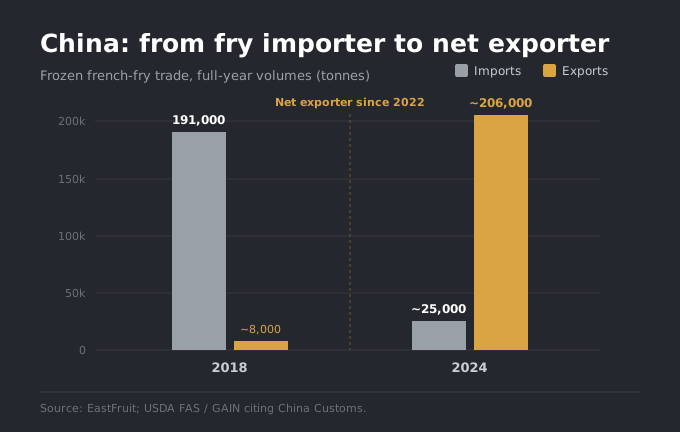
China's frozen french-fry imports collapsed from 191,000 tonnes in 2018 to barely 25,000 tonnes in 2024, and just 7,600 tonnes in the first five months of 2025 — the lowest level in decades. Over the same period it crossed to net-exporter status in 2022 and, by 2024, ranked as the eighth-largest fry exporter by volume and ninth by value, shipping roughly 206,000 tonnes for the full year and 139,000 tonnes in January–May 2025 alone.
An anti-dumping or anti-subsidy case needs a domestic industry being injured by imports. With EU fries now a negligible share of Chinese supply, that predicate barely exists. The asymmetry that drove the pork and dairy cases runs in the opposite direction for fries — which is precisely why a Chinese tariff on European fries is the wrong thing to watch.
Where the real exposure is
China's fry growth is concentrated in the markets EU-4 exporters also depend on. USDA-GAIN, citing China Customs, identifies the Philippines, Japan, Indonesia, Thailand and South Korea as the core destinations — buyers that previously sourced from the United States and Europe and shifted to Chinese product on price and proximity.
Order 834 reframes "supply-chain security" as an explicit state priority and pairs it with the counter-measure toolkit in Order 835. For a sector where China competes rather than imports, the channel that matters is competitive: continued policy support for an export-oriented Chinese fry industry undercutting European and American product in third markets, especially while Europe is working through a heavy crop. That pressure does not show up as a duty on EU fries; it shows up as lost share in Asian foodservice tenders.
What would change the picture
Three developments would move frozen potato from context into a live trade story, and are worth monitoring:
- A published "critical sector list" under Order 834 that names food, agriculture or staple crops.
- Any Chinese measure touching a potato-sector input that the EU or US does supply in volume — processing equipment, seed potatoes, or starch — rather than finished fries.
- EU or US trade action against Chinese frozen fries that invites retaliation under the Order 834/835 framework.
Until one of those lands, the honest read is that frozen potato is insulated from China's current agri-food tariff campaign by the simple fact that China no longer buys the product — but exposed, through the side door, to China as a subsidised competitor in the markets European processors most need right now.
