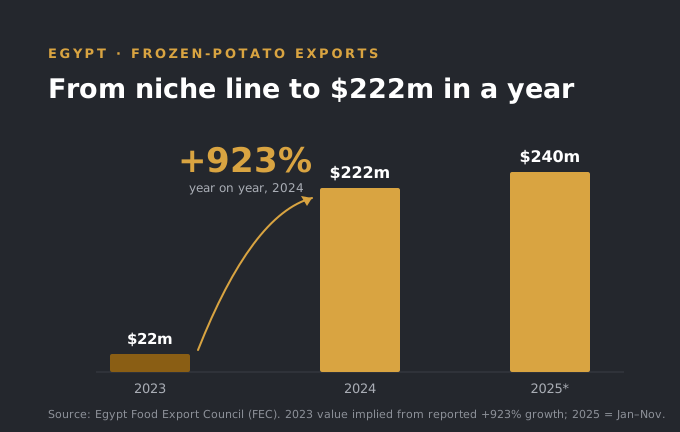
Egypt has quietly become one of the fastest-rising origins in frozen potatoes. Its frozen-potato exports jumped roughly 920% in 2024 to about $222 million — the single fastest-growing line in a record $6.1 billion processed-food export year, according to Egypt's Food Export Council (FEC). A country long known for shipping fresh potatoes is now standing up a processed-fries industry behind it, and a cohort of branded exporters is forming around the opportunity. MAF Gateway, an Egyptian exporter pushing its "Helmend" fry line into retail and foodservice, is one of the newer names in that cohort.
The number that matters
The FEC named frozen potatoes the fastest-growing category in Egypt's processed-food basket in 2024, reporting a roughly 923% year-on-year rise to about $222 million. (A few secondary outlets cited the jump in an 860–900% range; the FEC's own figure is the one used here.) That sat inside a record sector total of $6.1 billion, up 21% on 2023.
The percentage flatters a tiny starting point — frozen-potato exports were worth only around $22 million in 2023 — so the real signal isn't the spike itself. By value, frozen potatoes were still the smaller member of Egypt's frozen-produce trio: frozen strawberries led at about $383 million and frozen vegetables sat near $262 million. What matters is that frozen potatoes crossed from a rounding error into a genuine export line — and then held the gain. Through the first eleven months of 2025 the FEC put frozen-potato exports at about $240 million, up a further 16%. That deceleration is the point: this looks like a category settling into the mainstream, not a one-year anomaly.
Why Egypt, and why now
Egypt has the raw-material engine for this. It is already a major fresh-potato exporter — CAPMAS recorded roughly $409 million of potato exports in the first ten months of 2024, and the Ministry of Agriculture ranked potatoes second only to citrus among agricultural exports by volume that period, at close to 0.9 million tonnes. Harvests across winter and spring seasons, with cold storage stretching availability further into the year, give processors a long window of competitively priced potatoes.
Geography does the rest. Mediterranean ports at Alexandria and Damietta, plus Red Sea access and the Suez corridor, put Egypt within short sea transit of the Gulf and within reach of Europe. And Egyptian goods enter several large markets on preferential terms — the Greater Arab Free Trade Area, the Egypt–EU Association Agreement, COMESA in eastern and southern Africa, the Egypt–Türkiye agreement, and an Egypt–Mercosur deal that matters for South America. A growing domestic quick-service-restaurant scene gives the same processors a home market to scale against.
Where the fries are going
The pull is closest and cheapest to serve exactly where Egypt's processed food already sells. Across all processed food in 2024, the FEC reported Arab markets taking 54% of exports ($3.276 billion), with Saudi Arabia the single largest buyer at about $491 million, up 23%. The European Union followed at roughly $1.168 billion, non-Arab Africa at $513 million, and the United States at $330 million.
For frozen fries specifically, the Gulf is the obvious target: QSR-heavy, import-dependent, and a short shipment away. It is the same demand pool that has drawn European and North American fry exporters for years — only now an origin with lower costs and a Suez-side location is competing for it.
The case file: MAF Gateway
MAF Gateway for Export is a useful illustration of the newer wave. The company exports a frozen-fries line alongside pasta and tomato paste, and positions itself (on its own materials) around quality, flexibility, and private-label work for retailers, distributors, traders, HORECA buyers, and brand owners.
Its fry product, branded "Helmend," is described as flash-frozen from Egyptian potatoes and offered in straight, crinkle, and wedge cuts. The packaging spec points squarely at both channels the data favours: foodservice cases of four 10 kg bags (roughly 2,350 cases to a 40-foot container) for caterers and wholesalers, plus a 2.5 kg retail pack, with an 18-month frozen shelf life.
None of that is unique — that is the point. MAF sits among a field of newer branded Egyptian exporters chasing the retail, foodservice, and private-label demand the FEC numbers show is expanding, distinct from long-established processors such as the Farm Frites operation in Egypt. The interesting question is which of these newer names converts Egypt's origin advantage into durable buyer relationships.
What isn't proven yet
Three things temper the story. First, base effects: 923% off $22 million is not a number that repeats, and 2025's 16% is the truer run-rate — the test is whether Egypt holds share, not whether it spikes again. Second, the premium gap: entrenched European producers, the Netherlands above all, own the high-spec IQF know-how and the margins that come with it; competing on price is not the same as competing on value, and European producers have already begun flagging low-cost competition from origins including Egypt. Third, concentration and inputs: heavy reliance on Arab and Gulf buyers leaves the category exposed to a few markets, and Egyptian growers still lean on imported seed potatoes.
For a newer branded exporter like MAF, the open question is the one facing the whole cohort: whether origin advantage and cut-price volume can be turned into certified, repeat, relationship-based supply — the thing that actually defends a position once the novelty of a 900%-growth headline fades.
Bottom line
Egypt's frozen-fry rise is real, fast, and — on 2025's numbers — sticky rather than a one-year spike. The headline percentage flatters a small base, but the category has crossed into the mainstream of Egypt's processed-food exports and stayed there. For buyers, it adds a competitively priced, well-located origin to the frozen-fry map. For incumbents, it is a margin question. Companies like MAF Gateway are the live test of whether Egypt's branded exporters can move from cheap volume to trusted supply.
