The global frozen-fries industry is moving into a new phase in which production capacity expands beyond its traditional export heartlands and locates closer to fast-growing consumer markets, according to an analysis by DCA Market Intelligence (DCA) reported by Frozen Food Europe. DCA frames the shift as a reorganisation of supply chains rather than a fragmentation of the sector.
Europe stays dominant — but growth turns inward
DCA puts EU frozen-fries exports up 24.9% between 2020 and 2025, reaching 6.16 million tonnes. Much of that gain, the firm says, came from trade inside the bloc: intra-EU exports rose 34.9% to 3.54 million tonnes in 2025, while shipments to destinations outside the EU peaked at 2.86 million tonnes in 2023 before easing to 2.62 million tonnes in 2025.
Emerging exporters post triple-digit growth
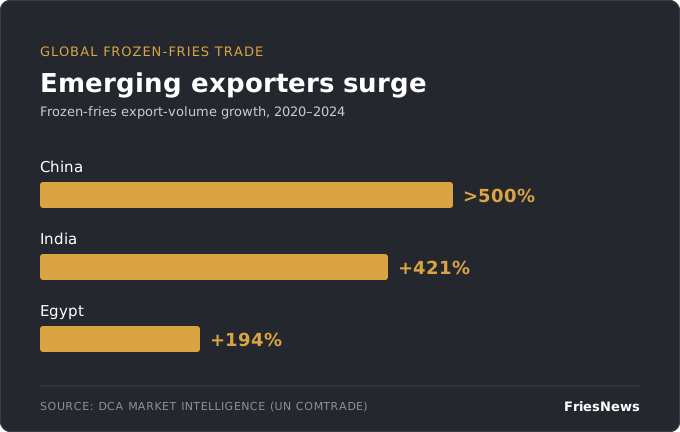
DCA identifies China, India and Egypt as the fastest-growing frozen-fries exporters, drawing on UN Comtrade data cited in its report. By DCA's reading, Chinese export volume rose more than 500% between 2020 and 2024 and export value climbed 535% to USD 260.1 million. Over the same window the firm puts India's export volume up 421%, and Egypt's export value up about 366% on volume growth of 194%. All three remain far smaller than the EU, DCA notes — but their growth rates outpace established suppliers, and the expansion is concentrated where consumption is rising fastest.
What is driving demand
DCA attributes the demand growth to rising disposable incomes, urbanisation and the continued spread of quick-service restaurant chains across Asia, the Middle East, North Africa and parts of South America.
Capacity follows the consumer
To serve those markets, DCA says, producing countries are investing in domestic processing. The firm reports that China and India have expanded capacity through investments by major international processors including McCain Foods, Lamb Weston, Farm Frites, Agristo and Aviko; that Egypt has strengthened its role as a supplier to Mediterranean and Gulf markets; and that Brazil has built out local capacity to reduce import dependence.
One price, many origins
Despite the shifting geography, DCA finds frozen-fries pricing remains tightly linked across regions. It puts EU export prices up roughly 69% to EUR 1,279 per tonne in 2023, stabilising near EUR 1,232 per tonne by 2025. In North America, the firm reports US export prices up about 45% to USD 1.68 per kilogram in 2024 and Canadian prices up about 35% to USD 1.38 per kilogram. Export prices in China, India and Egypt generally moved between USD 1.00 and USD 1.40 per kilogram across 2023–2024 — which DCA reads as evidence that new suppliers are trading inside a common global pricing framework.
DCA ties the convergence to shared cost pressure, energy above all. The firm cites TTF natural-gas prices rising from EUR 14.85/MWh in 2020 to EUR 132.41/MWh in 2022 before easing, alongside higher packaging, labour, logistics and production costs. It adds that energy markets continue to react to geopolitics, with European gas and Brent crude under renewed upward pressure after recent tensions in the Middle East.
Distributed production, concentrated ownership
DCA cautions that diversifying production geographically does not necessarily diversify market power. Much of the new capacity, it says, is being built by the same multinationals that have long dominated the sector through processing plants, contract-farming systems, cold-storage infrastructure and technical-support networks — leaving the industry more geographically distributed but still relatively concentrated in ownership and influence.
Outlook
Europe remains the dominant exporter, DCA says, but faces growing competition from regional suppliers able to serve nearby markets more efficiently. On the firm's view, future growth will depend less on long-distance exports and more on regional processing hubs built to supply rapidly expanding consumer markets — a regionalisation DCA characterises as the next stage in a globally connected market rather than a sign of fragmentation.
