- 435,172 t+7.3%
- 12-month imports · record (by volume)
- ¥112.7bn+4.0%
- Import bill · ≈US$705m / €607m
- ≈60%
- US share of volume · down from prior years
- ¥258,914/t
- Avg import price · ≈US$1,619 / €1,396
Japan has never bought more frozen fries. Imports of frozen prepared potatoes reached a record 435,172 tonnes in the 12 months to April 2026 — but the headline masks a quieter reordering of who supplies them. The United States still dominates, yet the marginal tonne is increasingly going to cheaper Asian and North American product.
01Overview
A record bill, in a weakening yen
The 12-month total of 435,172 tonnes was up 7.3% by volume, while the import bill rose a softer 4.0% to ¥112.7bn — about US$705m or €607m. That gap between volume and value growth is the story in miniature: the average import price eased to ¥258,914/tonne as lower-cost suppliers took share. Working against importers, though, is the currency. With the yen near ¥160 to the dollar and roughly 10% weaker over the year, every tonne bought abroad costs more in yen even as global fry prices come off — pressure sharp enough that Tokyo intervened to support the currency in late April and May, citing food-import costs among its concerns.
02Incumbent
The US still leads — but by less
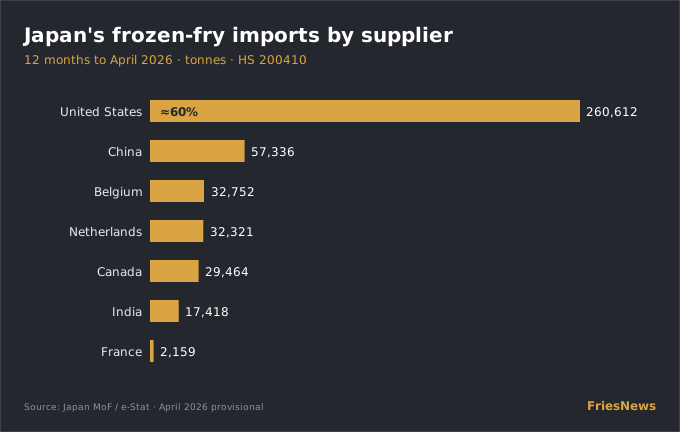
The United States shipped 260,612 tonnes over the year, close to 60% of all Japanese fry imports, and held an average price of ¥274,910/tonne — a clear premium to every challenger. But its position is essentially flat: volumes were broadly steady over the year and dipped slightly in the latest month. The premium tier is American; the growth is not. Separately, the US industry continues to press for wider access to Japan's fresh-potato market — a different product line, but a sign of how much weight exporters place on Japanese demand.
03Challengers
China and India take the new tonnes
China lifted its 12-month total to 57,336 tonnes — about 13% of the market and up roughly half on the year. India reached 17,418 tonnes, up by more than 70%, and Canada 29,464 tonnes, up around a quarter. The common thread is price: China lands at ¥200,917/tonne and India at ¥205,377, both roughly a quarter below the US level. That is what pulls the world average down and explains why Japan's bill grew more slowly than its volume. The pattern looks structural rather than seasonal — incumbent capacity holding the premium core while newer Asian and North American supply absorbs the incremental demand.
04Europe
Europe in retreat
European origins moved the other way. Belgium fell to 32,752 tonnes over the year (down close to a fifth), the Netherlands to 32,321 (down around a quarter) and France to 2,159 (down about a third). Two forces are at work: disruption to Middle-East shipping lanes has lengthened the Europe-to-Asia route, and Europe's own supply and pricing dynamics have left less competitively-priced product for distant markets.
| Supplier | 12-mo tonnes | Share | 12-mo value | ≈US$ | Avg ¥/t | Δ value YoY |
|---|---|---|---|---|---|---|
| United States | 260,612 | 59.9% | ¥71.64bn | $448m | ¥274,910 | +3.1% |
| China | 57,336 | 13.2% | ¥11.52bn | $72m | ¥200,917 | +44.5% |
| Belgium | 32,752 | 7.5% | ¥8.32bn | $52m | ¥254,038 | −19.1% |
| Netherlands | 32,321 | 7.4% | ¥7.90bn | $49m | ¥244,340 | −23.1% |
| Canada | 29,464 | 6.8% | ¥7.86bn | $49m | ¥266,806 | +23.0% |
| India | 17,418 | 4.0% | ¥3.58bn | $22m | ¥205,377 | +78.1% |
| France | 2,159 | 0.5% | ¥0.54bn | $3.4m | ¥248,480 | −32.7% |
| World | 435,172 | 100% | ¥112.67bn | $705m | ¥258,914 | +4.0% |
