At a glance
- Production (2024)
- 2.118 Mt
- Harvested area (2024)
- 225,950 ha
- Average yield (30–40 t/ha potential)
- ≈10 t/ha
- Value-chain contribution (2023 est.)
- US$470m
- Counties growing potatoes
- 29 of 47
FAOSTAT
FAOSTAT
Ministry of Agriculture, via World Potato Markets
≈KSh 61bn
NPCK
01Geography
Where Kenya grows its potatoes
Potatoes are grown across 29 of Kenya's 47 counties — 16 major and 13 minor growing counties — concentrated in the highlands at 1,500 to 3,000 metres above sea level, across the Western, Rift Valley, Eastern and Central regions. The core growing belt suits the crop well, with 1,200–1,800 mm of rainfall a year and temperatures of 15–24°C; investment in irrigation and technology is now opening up other areas. About 90% of national output comes from smallholdings of half an acre to two acres, with larger commercial farms typically under irrigation. On those small farms, roughly 90% of the crop is sold to the local market, often grown as a pure stand but rotated with maize, beans and other crops.
- 1
Short Rains
Early October to end December.
- 2
Long Rains
Early March to June; the bulk of the crop is grown here.
- 3
Irrigation
Growers who can irrigate produce off-season, giving them a market-timing advantage.
02Production
Production, yields and the gap
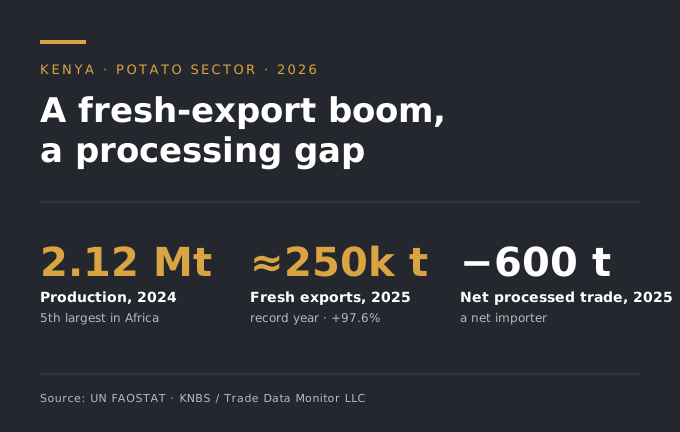
National production runs between roughly two million and 2.5 million tonnes. In 2024 Kenya produced 2.118 million tonnes, according to UN FAOSTAT — the 31st largest crop in the world and the 5th largest in Africa, after Egypt, Algeria, South Africa and Morocco. It also harvested the 13th largest potato area in the world that year, 225,950 hectares, sitting between Egypt and France. The value chain was estimated to add 61 billion Kenyan shillings (about US$470 million) to the economy in 2023. The headline weakness is yield. Severino Manene, Kenya's Assistant Director for Agriculture in the Ministry of Agriculture & Livestock Development, told World Potato Markets that yields average around 10 tonnes a hectare against a potential of 30–40 tonnes — a gap he attributes to limited crop rotation (driven by land fragmentation as the population grows), pest and disease pressure, and a shortage of climate-resilient varieties.
03Inputs
Breeding and the cold-chain bottleneck
Potato breeding is led by the government's KALRO (Kenya Agricultural & Livestock Research Organisation) in collaboration with partners including the International Potato Center (CIP), working to develop and disseminate improved varieties suited to local conditions. Manene flags the need for climate-resilient varieties — resistant to diseases such as late blight and able to withstand erratic weather. A shortage of storage and cooling capacity is a second structural constraint: without it, growers cannot hold stock to sell when prices are best. The government is supporting construction of cold storage managed by Farmer Producer Groups and farmer co-operatives, and encouraging growers into marketing groups to strengthen their hand in the value chain and reduce reliance on middlemen.
04Policy
A nine-point national strategy
Kenya's potato industry has been guided since 2016 by the National Potato Strategy, published by the National Potato Council of Kenya with the Ministry of Agriculture and partners. The current strategy — the 2021–2025 cycle, now at its end — sets out nine aims:
- Strengthened institutional, legal and regulatory framework
- Enhanced research in the potato industry
- Potato variety development and seed production
- Increased potato production
- Post-harvest management, value addition, marketing and utilisation
- Enhanced import, export and trade
- Enhanced use of data management tools
- Increased participation of youth and women in potato value-chain businesses
- Enhanced industry coordination and funding
05Trade
Trade: a record year for fresh exports
Fresh-potato exports are variable year to year, with the vast majority going to neighbouring Uganda. In 2025, Kenya exported almost 250,000 tonnes of fresh potatoes — up 97.6% on 2024 and a record — with Uganda taking all but 760 tonnes and South Sudan 595 tonnes. Exports have risen steadily since 2020. The average fresh-export price fluctuates; in 2025 it was about US$313 a tonne. Seed-potato exports are climbing too: 1,125 tonnes left the country in 2025, up sharply from 128 tonnes in 2024, with Uganda taking 915 tonnes and Somalia 209, at an average US$502 a tonne.
Fresh
≈250,000 t · +97.6% YoY (record)
About US$313 a tonne in 2025; almost all of it to Uganda.
Seed
1,125 t · up from 128 t in 2024
About US$502 a tonne; Uganda and Somalia the main buyers.
Processed
340 t exported vs 940 t imported
A net importer; Egypt supplies the bulk of the imports.
06Processing
The processing gap
This is where Kenya's potato economy diverges most sharply from its growth story. Against record fresh and rising seed exports, processed-product exports are negligible: just 340 tonnes of frozen fries, dehydrated and chip/crisp shipments were recorded in 2025, going mainly to Uganda and Tanzania. Over the same year Kenya imported 940 tonnes of processed potato products, with Egypt responsible for 670 tonnes — leaving the country a net importer of the very products its market is starting to want. The deficit is small in absolute terms, but its direction matters. The structural constraints that cap value capture in fresh potatoes — thin cold-chain infrastructure, low yields, fragmented holdings — are the same ones that must be solved before domestic processing can scale. As urbanisation and changing diets lift demand for fries and crisps, the value currently leaking to imports is the clearest commercial opening in the sector. Whoever builds processing capacity, domestic or foreign, stands to capture it.
07Demand
Demand, demographics and a consumption paradox
Kenya's population was an estimated 53.3 million in mid-2025, growing nearly 2% a year. UN median projections put it at 82 million by 2050 and above 100 million sometime in the 2070s. Urbanisation is accelerating: about 30% of the country is urban today, forecast to reach 50% by 2050 at a 3.4% annual urbanisation rate. Nairobi has 4.4 million people and Mombasa 1.2 million, with five other cities above 300,000.
A consumption paradox
Production has climbed for most of the past decade, yet per-head potato consumption has slipped — the FAO puts average potato and potato-product consumption at 29.7 kg per person in 2023, down from 32.1 kg ten years earlier. Output is rising, but not as fast as a population growing nearly 2% a year. Urbanisation and changing diets, though, point the other way for processed demand.
08The event
WPC 2026: the first in Sub-Saharan Africa
Kenya will host the 13th World Potato Congress from 26–30 October 2026 at the Sawela Lodges and Convention Centre in Naivasha, on the shores of Lake Naivasha in the Great Rift Valley — the first WPC ever held in Sub-Saharan Africa. The event is hosted by the National Potato Council of Kenya and FreshCrop Limited under the theme "Global Potato Partnership for Enhanced Food Systems, Nutrition Security and Trade", and is expected to draw more than 1,000 delegates. It comes to Kenya after the originally scheduled Gdańsk, Poland edition was cancelled. More at wpc2026kenya.com.
09Outlook
Outlook
Manene is optimistic about the sector's trajectory, pointing to ideal growing conditions across much of the country, increasingly organised and tech-enabled farmers, more resilient varieties, and a growing, urbanising population — at home and across the region — that is reshaping eating habits and lifting demand. The prize, for Kenyan growers and for the wider industry, is moving up the chain: from raw tubers toward processed value, and toward closing an import gap that a maturing market will only widen.
