- ~13M t
- 2025–26 harvest (record)
- ~50%
- Export market disrupted
- Rs 235–250k
- Grower loss per acre
- Apr 8, 2026
- Russia reopens to Punjab
01Supply
How a record harvest became a liability
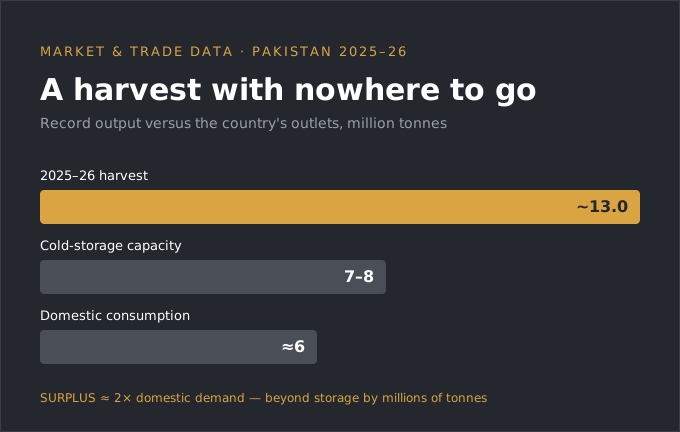
Pakistan's potato sector has been one of its agricultural success stories — output climbing on better seed, agronomy, and state support until the country reached ninth in the FAO's global producer ranking in 2023. That success became its own trap. Drawn by margins well above wheat or rice, growers in Punjab and Khyber Pakhtunkhwa expanded acreage aggressively. In 2024–25, national output hit 9.9 million tonnes — 44.7% above the Federal Committee on Agriculture's target — as planted area jumped 41% to 378,100 hectares. Punjab, the overwhelming majority of the crop, produced 9.81 million tonnes on its own. The 2025–26 crop went further still, reaching a record ~13 million tonnes by the food security minister's own account.
Set against domestic consumption estimated at 4.5–6.2 million tonnes and cold-storage capacity capped at 7–8 million tonnes, the arithmetic was unforgiving: a surplus near twice what the country could eat, and millions of tonnes with no shelf to sit on.
| Metric | 2024–25 | 2025–26 |
|---|---|---|
| National output | 9.9M t (+44.7% vs target) | ~13M t (record) |
| FCA target | 6.8M t | 8.92M t |
| Planted area | 378,100 ha (+41%) | — |
| Punjab output | 9.81M t | overwhelming majority |
| Storage capacity | 7–8M t | 7–8M t |
02Corridors
The corridor collapse: two exits shut at once
Pakistan's export model rested on a single hinge — Afghanistan, which was both the largest end market and the overland gateway to Central Asia and Russia. In 2023, Pakistan shipped 755,811 tonnes of potatoes worth $140 million, 41% of it to Afghanistan; 2024 was similar at 736,062 tonnes and $138 million, with Afghanistan again near 42% (ITC Trade Map).
Two shocks closed that hinge. Russia restricted Punjab potatoes in May 2025 over phytosanitary concerns — the potato tuber moth and Tomato Spotted Wilt Virus. Then in October 2025, after deadly border clashes, Islamabad sealed the Chaman and Torkham crossings, cutting not just direct Afghan sales but the transit route beneath them. Officials told a National Assembly committee that roughly half the export market — Afghanistan and Russia combined — had been knocked out.
03Growers
What it did to growers
With exports stalled and storage still holding unsold 2024 stock, the new crop hit the market in early 2026 and prices fell through the floor. Across Punjab's potato belt — Sahiwal, Okara, Pakpattan, Kasur, Vehari — farmgate prices dropped to Rs 20–25 per kilogram, below break-even. Against cultivation costs near Rs 300,000 per acre, the Pakistan Kisan Ittehad put grower losses at Rs 235,000–250,000 per acre and called 2025 a devastating year. A 60-kilogram bag held in cold storage fetched only Rs 600–700 in the open market while transport alone ran Rs 400; rather than pay to move worthless stock, some growers ploughed standing crops back into the soil or fed them to livestock.
04Response
The response — and the partial reopening
Islamabad's answer ran on two tracks: clear the surplus and rebuild the corridors. A Committee on Potato Export under food security minister Rana Tanveer Hussain met repeatedly through early 2026; by its fourth meeting on 4 March, the government was weighing targeted transport subsidies and concessional freight to offset the cost of longer routes. With Afghanistan shut and Iran's transit unsettled, two alternatives moved to the front: the Zahedan–Taftan land route through Iran, and — more strategically — a corridor through China via the Khunjerab Pass to reach Central Asia, with a high-level committee under Deputy Prime Minister Ishaq Dar formed to steer it.
The most consequential development came in April. Russia lifted its Punjab ban effective 8 April 2026, after Pakistan's plant-protection authorities submitted pest-status records and laboratory diagnostics; three exporters were cleared in the first phase. It was the first real outlet to reopen — but a partial one.
- 1
May 2025
Russia restricts Punjab potatoes over phytosanitary concerns.
- 2
Oct 2025
Afghan border (Chaman, Torkham) sealed after clashes; transit and end market lost at once.
- 3
Early 2026
New crop floods the market; growers report Rs 235–250k/acre losses.
- 4
Feb–Mar 2026
Potato Export Committee weighs freight subsidies and China/Iran routes.
- 5
8 Apr 2026
Russia reopens to Punjab potatoes — three exporters, first phase.
05Analysis
The FriesNews read: a reopening, not a resolution
Russia's reopening is a relief valve, not a fix. Three approved exporters and a single market cannot absorb a surplus running to several million tonnes — Pakistan is itself targeting up to 4 million tonnes of exports out of the ~13 million produced. The China route remains aspirational: high-altitude, visa-dependent, and unproven for perishable bulk freight. Freight subsidies, meanwhile, treat the symptom — cost — rather than the disease, which is the absence of a domestic buffer.
Two structural facts will outlast this season. First, the storage-and-processing gap: until cold-chain capacity and processing — the value-addition that turns a perishable glut into freezable, storable product — catch up with output, every good harvest is a latent crisis. Second, single-corridor dependence: routing a strategic export through one volatile neighbour is what converted a price dip into a rural emergency.
For the processed-potato industry, the signal is specific. Pakistan is a low-cost, high-volume grower with a chronic outlet problem — precisely the profile that, with processing investment, becomes a fries-and-flake supplier rather than a fresh-tuber exporter at the mercy of a single border gate. The 2025–26 glut is the clearest argument yet for that pivot. Without it, the glut is widely expected to recur in 2026–27.
