01
The integration play
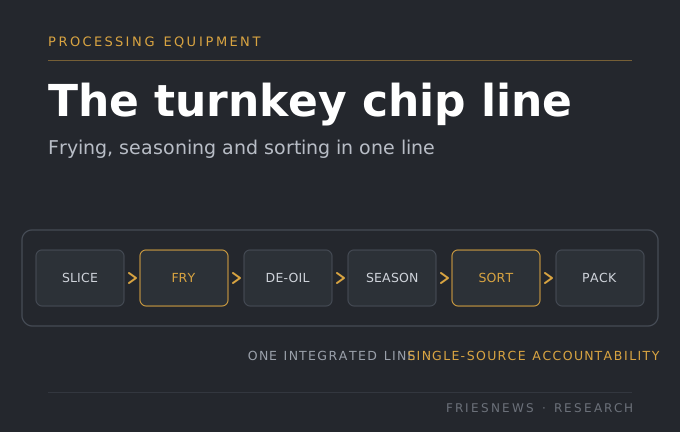
For decades, a chip line was something a processor stitched together — a fryer from one specialist, a seasoning drum from another, a sorter from a third, conveyors and packaging from others again. That model is under pressure. Ahead of SNACKEX in Lisbon (17–18 June 2026), PPM Technologies and Key Technology — both Duravant operating companies — have unveiled a fully integrated potato chip processing line, to be shown at the fair, that runs from slicing through packaging as one unified system, bringing PPM's frying, seasoning and product-handling together with Key's optical sorting.
The companies frame it squarely around the problems processors are wrestling with now: raw-material variability, labour shortages, and the coordination demands of high-volume chip production. The promise is consistent quality, more usable product recovered, fewer people on the line, and one accountable supplier backed by global service — a single point of contact when something goes wrong, instead of several vendors pointing at each other. It is a small launch in isolation. As a signal, it is the clearest recent expression of where chip-line procurement is heading.
02
Inside the line: smart frying, precise seasoning, optical sorting
What is actually in the line maps onto capabilities the snack-equipment field has been advancing for years, now bundled into one tuned package. On the cooking side, the fryers carry advanced oil filtration to extend oil life and cut operating costs, with clean-in-place capability to limit downtime during sanitation. PPM's broader fryer platform — the CookWright system it introduced in 2025 — pairs precise temperature management with oil filtration and strategically placed sensors feeding plant-wide monitoring networks. That is the "smart frying" idea in concrete form: the fryer as a data node, not just a heat source.
After frying, sorting is the last line of defence before product reaches packaging. Key's COMPASS optical sorter combines multi-channel sensor data with multi-wavelength strobing to identify dark spots, green discolouration and white knots, as well as fryer debris — and it does so without the laser-based systems that can push up maintenance costs. Seasoning sits between the two, where PPM's seasoning and coating equipment handles flavour application. The point of integrating these stages is that cook, coating and defect removal are engineered to each other rather than bolted together after the fact — which is precisely what is hard to achieve when each box comes from a different supplier.
03
The energy and oil-cost dimension
Underneath the automation story is a harder commercial one: energy and oil. Frying is the most energy-intensive and oil-dependent stage of a chip line, and rising utility and oil costs have moved fuel efficiency and oil life from a footnote to a procurement priority. PPM positions its fryers around protecting oil quality, reducing downtime and saving operating costs, with the CookWright generation specifically aimed at improving fuel efficiency alongside filtration.
Why opex, not throughput, is driving the upgrade cycle
A line that extends oil life and trims energy per kilogram changes the unit economics as much as raw speed does. For many processors, that operating-cost case — not any single automation feature — is what justifies replacing a working line.
The same pressure runs across the field. Heat and Control, one of the largest line builders, markets oil-mist reduction, energy-recovery and water-efficiency systems spanning frying, conveying, seasoning, weighing, packaging and inspection. When two of the heaviest-cost inputs in chip making are oil and energy, the supplier that can credibly cut both has a commercial argument that lands with finance, not just operations.
04
Who actually builds these lines
It is worth correcting a confusion that recurs in market commentary: the vendors in this market are not the chip brands. Snack makers — Frito-Lay, Calbee, Intersnack and the rest — buy lines; they do not sell them. The companies that actually build potato chip processing lines are a smaller, specialised field.
| Line builder | Base | Notable strength |
|---|---|---|
| Heat and Control | US / global | Full snack lines; frying, seasoning, energy and water systems |
| Duravant (PPM Technologies + Key Technology) | US | Integrated frying, seasoning and optical sorting |
| Bühler | Switzerland | Processing and sorting technology |
| GEA | Germany | Frying and processing systems |
| TNA Solutions | Australia | Frying, seasoning and packaging |
| Kiremko / Rosenqvists | Netherlands / Sweden | Potato frying and processing lines |
What unites them now is direction of travel: the field is consolidating capabilities toward turnkey, single-source lines. Duravant's structure — multiple equipment brands under one automation group, cross-integrated — is the clearest expression, but the integration logic is industry-wide, and the competitive battleground is shifting from individual best-in-class boxes to who can deliver the whole line as one coherent, data-connected system.
05
What it means for processors
For a chip producer weighing a new line, the integration shift reframes the decision. The case for single-source turnkey is real: tighter quality control because stages are engineered together, faster commissioning, fewer integration headaches, one accountable supplier, and a single data layer across the line for monitoring and optimisation. The case against is equally real: higher upfront capital, less freedom to pick best-in-class at each stage, and tighter lock-in to one supplier's ecosystem and service network.
Why it matters for the industry
Smaller and artisanal producers may still favour modular, mix-and-match builds that let them stage investment and swap components over time. The integrated line is not automatically the right answer — but it is increasingly the default option on the table, and the buyer's question is shifting from "which fryer, which sorter" to "build it myself or buy it whole."
Takeaway The headline here is not a number; it is a procurement model. Chip lines are increasingly sold whole, and the contest among equipment makers is integration — frying, seasoning and sorting tuned as one system, with energy and oil efficiency as the commercial hook.
