01Positioning
Where the Optyx fits
Optical sorting has become the quality-and-yield backbone of the modern potato line, and the Optyx is Key Technology's workhorse for low-to-medium volumes. Rather than a single machine, Optyx is a family of belt sorters that can be configured with different cameras and lasers, viewing the product from one or both sides, to match a given application. The platform handles wet or dry products and is built around a simple, icon-driven operation that keeps changeover and cleaning straightforward.
- Up to 12 t/h
- Optyx 6000 max throughput
- 2–3-way
- Sort streams
- 1–3%
- Yield lift from Sort-to-Grade (Key Technology)
- 2018
- Duravant acquired Key Technology
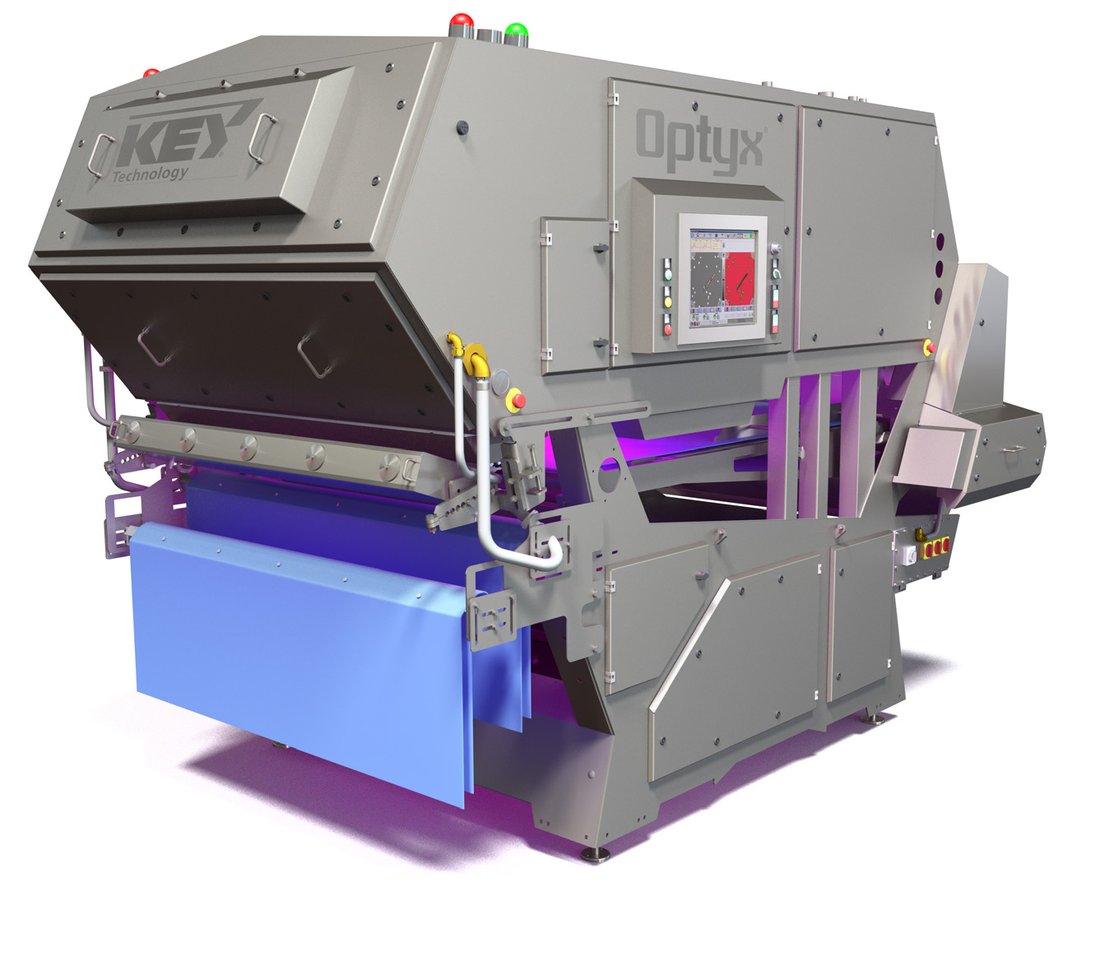
In Key's broader range, the Optyx sits below VERYX — the company's flagship, marketed as its most powerful digital sorter for high-capacity work with all-sided surface inspection. For processors who do not need that ceiling, the Optyx delivers the same core method — see, decide, eject — at a smaller footprint and lower throughput band.
02Sensing
How it sorts: cameras, lasers, lighting
The Optyx pairs two complementary sensing approaches. Cameras read color, shape, size and texture; configurations include high-resolution visible/infrared (Vis/IR), ultraviolet (UV), and tri-chromatic options. Lasers add a second dimension, detecting material by its structural properties rather than appearance — useful for catching foreign material that looks similar to good product but behaves differently under a laser. The Optyx supports both infrared and fluorescence (fluo) lasers, working "in air" as product passes between the belt and the ejection point. A range of lighting options — HID, UV and LED — supports the different sensor modes.
Once a defect or piece of foreign material is identified, an intelligent ejection system fires precision pneumatic valves with a fast response time to knock the targeted piece off-stream. Because the decision and the ejection are both fast and piece-by-piece, the machine can pull out small defects without sacrificing large amounts of good product alongside them.
03Software
The software layer: tracking, grading and remote monitoring
The Optyx is as much software as hardware. Object-based image processing lets the sorter analyze each piece against custom criteria — shape, length, width, curvature, symmetry, circularity and other characteristics — so the definition of a "defect" can be tuned to the product and the customer's quality target. Key's FMAlert function tracks foreign material and logs it, giving processors a digital record of what was caught and when.
For fry lines specifically, Key offers Sort-to-Grade on its belt-driven G6 sorters, including Optyx. The feature grades output by accepting or rejecting pieces to hit a defined quality grade, and Key states it can lift yields by roughly one to three percent. A subset, Simplified-Length-Control, focuses on french-fry strip length and automatically preserves the finished length profile even as incoming strip sizes vary — letting processors lean less on mechanical length graders, which can damage product.
On the maintenance side, Key's RemoteMD monitors sorter condition and flags changes that affect performance and reliability, with web-based diagnostics intended to maximize uptime.
04Models
Models, capacity and footprint
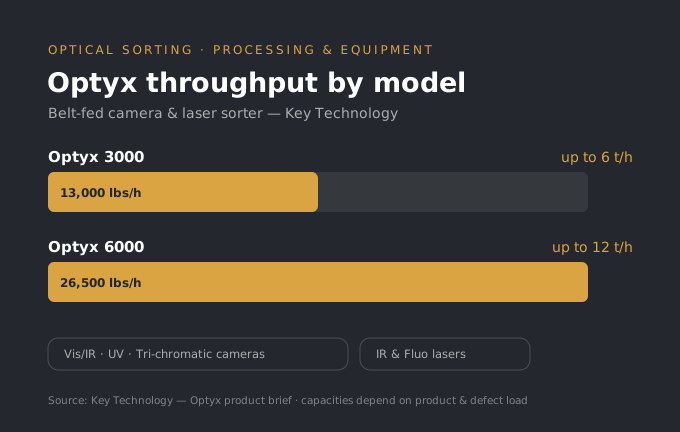
The two principal potato-relevant models are the Optyx 3000 and the wider Optyx 6000. Capacities are stated by Key Technology and depend on the product and the defect load.
| Spec | Optyx 3000 | Optyx 6000 |
|---|---|---|
| Max throughput | Up to 6 t/h (≈13,000 lb/h) | Up to 12 t/h (≈26,500 lb/h) |
| Length | 2,815 mm (111") | 3,276 mm (129") |
| Height | 2,272 mm (89.5") | 2,413 mm (95") |
| Width | 1,198 mm (47.2") | 2,080 mm (82") |
| Sort streams | Two- or three-way | Two- or three-way |
The optional three-way sort is where extra yield often hides: instead of simply splitting good product from waste, a third stream lets a processor separate good product into distinct grades, or isolate borderline product that can be reworked and recovered rather than dumped with the foreign material.
Capacity figures are ceilings that assume a manageable defect load — a dirtier or more defect-heavy input stream will sort slower.
05Applications
Applications on the potato line — and beyond
For a frozen-and-processed-potato audience, the relevant point is breadth of format. Key lists the Optyx as suitable for potatoes as chips, whole, strips, sliced, diced and wedges — effectively the full slate of cut formats a processor runs. Beyond potatoes, the same platform is used across fruits, nuts, vegetables, cereal, confectionery, dry beans, fresh-cut produce (including core removal), raisins and snack foods.
Two illustrative use cases show the range. Green-bean processors have used an Optyx 3000 to re-sort the reject streams from other sorters, clawing back good product that would otherwise be lost. And with a fluo laser, an Optyx 6000 has been used in fresh-cut to remove the core after lettuce heads are cut with conventional equipment — a sorting job that would otherwise be done by hand. The headline outcomes Key associates with the platform are higher yields, lower labor costs and longer shelf life.
For the wider picture of how camera-and-sensor systems are reshaping the fry line — including how the Optyx stacks up against rival platforms from TOMRA — see our companion piece on AI optical sorters on the fry line. For where sorting fits in the overall production sequence, see how frozen french fries are made.
06Ownership
The company behind it
Key Technology is a Walla Walla, Washington manufacturer of digital sorting, inspection, conveying and processing equipment, with a history in the valley stretching back decades and a long focus on potatoes among its core markets. In January 2018, the engineered-equipment group Duravant agreed to acquire Key in a deal valued at roughly $175 million; at the time Key had annual revenue of about $140 million and operations spanning the United States, the Netherlands, Belgium, Australia and Mexico. The Optyx brief carries Key's "A Duravant Company" branding accordingly.
That ownership matters for buyers mainly in two ways: continuity of the installed base — Key's belt sorters are designed for forward-compatible upgrades on the G6 electro-optical foundation — and the breadth of a larger equipment group standing behind service and parts.
07Caveats
The honest caveats
A few things worth weighing rather than glossing over. The Optyx is a light-to-medium platform by design; processors running very high volumes are steered toward VERYX, so the Optyx is not the right tool for every line. And the most eye-catching performance claims here (the one-to-three-percent yield lift from Sort-to-Grade, for instance) are Key Technology's own, made for its own equipment; they are a reasonable guide to intent, not an independently audited benchmark.
