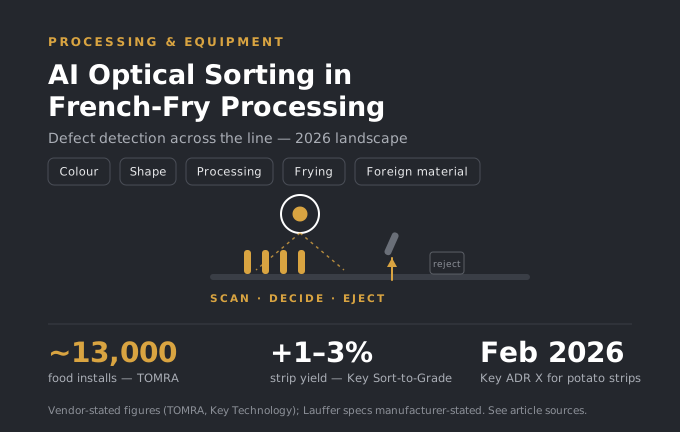
At a glance
- TOMRA Food installed base
- ~13,000 food installations
- TOMRA 5B inspection
- 360° surround-view, camera + laser
- Key Sort-to-Grade yield uplift
- +1–3% on potato strips
- Key ADR X for potato strips
- Launched 12 Feb 2026
- Bühler SORTEX F
- End-of-line frozen-fry FM + colour-defect removal
- Lauffer HWFT3 (manufacturer-stated)
- 1200 mm belt · 240 nozzles · 4.7 kW
TOMRA Food
TOMRA Food
Key Technology
Key Technology
Bühler
Lauffer Vision, manufacturer-stated
01Why it matters
Sorting is a control point on the line
On a modern fry line, optical sorting is not a finishing touch — it is a control point where four of a processor's biggest exposures are managed at once. The most acute is mechanical: foreign material that reaches the slicing knives can chip or break them, and a damaged cutter can halt the line. Catching wood, plastic, packaging, glass and stones upstream is therefore as much an uptime measure as a food-safety one.
The same inspection step governs two further economics. On yield, precise piece-by-piece decisions recover usable product that cruder grading would discard — and across millions of tonnes, a single percentage point is material. On labour, automated inspection replaces the banks of workers who once watched product rush past on a belt, at a time when that labour is scarce and costly. A sorter that performs well does all four jobs from one position in the process; one that performs poorly puts food safety, throughput, yield and cost all at risk together.
02The taxonomy
What the machines look for
Vendors converge on a similar defect taxonomy for potato strips and pieces. Across the suppliers surveyed here, the categories an optical sorter is trained to separate fall into five groups.
| Defect category | What the sorter is looking for |
|---|---|
| Colour | Browning, greening, black spot, mould |
| Shape | Broken, deformed, under/oversize, skin remnants |
| Processing | Abrasions, crushing, uneven cuts, starch bleeding |
| Frying | Burnt ends, oil stains, blistering |
| Foreign material | Wood, plastic, packaging, glass, stones |
The categories matter because they map to different sensing needs. Colour and frying defects are largely visible-spectrum problems; black spot can be millimetre-scale — TOMRA cites its 5B detecting millimetre-sized black spots in a customer case at BS Cocinados. Foreign material is the category where a contaminant may look like good product to a camera but behave differently under a laser, which is why the leading machines fuse more than one sensor rather than relying on cameras alone.
03How it works
Sensor fusion, AI classification, air ejection
The method is consistent across vendors even where the implementations differ: see the piece, decide on it, eject it — fast enough to run at line speed.
- 1
Sense
High-resolution RGB cameras read colour, shape and size; laser sensors add detection by structural property; LED or other illumination supports the sensor modes. Pieces are inspected on the belt or thrown 'in air' so they can be viewed from all sides.
- 2
Classify
Machine-learning and deep-learning models, trained on images across varieties, defects and seasons, distinguish a genuine defect from harmless natural variation — the hard part, since it governs both false rejects (lost yield) and false accepts (a safety or quality miss).
- 3
Eject
An intelligent ejection system fires precision air nozzles to knock targeted pieces off-stream, piece by piece, so small defects can be removed without taking large amounts of good product with them.
- 4
Grade and connect
The newer layer moves beyond raw foreign-material removal toward sort-to-grade and sort-to-spec decisions against an aggregate quality target, and toward connected data platforms that log performance for analysis.
That last step is the direction of travel in 2026: from a machine that simply removes contaminants toward one that grades output to a defined specification and feeds the result back as data.
04Incumbents
The competitive landscape, 2026
Three established providers anchor the category, each publishing an installed base, named customers and a software layer.
TOMRA Food is among the largest sensor-based sorting providers, reporting roughly 13,000 food installations globally. For potatoes it offers the TOMRA 5A, an in-air sorter designed for processors handling washed and peeled potatoes for fries and chips, with top and bottom optical banks inspecting each piece in flight; and the TOMRA 5B, a belt sorter that uses 360° surround-view from cameras and laser sensors with shape algorithms, which TOMRA says can detect millimetre-sized black spots. Its software layer spans Sort-to-Spec (smart ejection, statistical analysis and monitoring), Peel-to-Spec (which TOMRA says auto-adjusts steam time to cut peel loss) and the TOMRA Insight data platform. TOMRA names Lamb Weston / Meijer among its fry-industry users. One TOMRA customer reports sorting efficiency above 95% at 15–20% input defect levels, with roughly one-in-eight rejection on 10×10 cuts at over 6.5 tonnes an hour — figures TOMRA presents as a customer's results rather than an audited benchmark, and which should be read as such.
Key Technology, part of Duravant and headquartered in Downers Grove, Illinois, builds the VERYX platform — a modular chute-fed and belt-fed digital sorter whose multi-sensor Pixel Fusion combines high-resolution cameras and laser, configured for wet and frozen French fries and potato specialties. Its Sort-to-Grade (STG) function, Key states, categorises every surface defect and each strip's dimensions and makes accept/reject decisions against the aggregate "in-the-bag" grade — raising yields by one to three percent and letting processors eliminate mechanical length grading. Key dated two 2026 developments: it launched ADR X for potato strips on 12 February 2026, and on 25 February 2026 reported that Bem Brasil had expanded potato-strip production with an integrated Key line.
Bühler's SORTEX optical sorting uses cameras, lighting, lasers, hyperspectral imaging and machine-learning software. The SORTEX F (PolarVision) is a hygienically designed unit for frozen fruit and vegetables, used for end-of-line frozen-French-fry foreign-material removal — wood, plastic, cardboard and glass — alongside black and green colour-defect sorting; Bühler lists it with 128, 256 or 384 ejectors and 600, 1200 or 1800 mm chutes. The newer SORTEX AI700 positions Bühler on the machine-learning front of the category.
| Vendor | Potato/fry platform | Sensing | Software / data layer |
|---|---|---|---|
| TOMRA Food | 5A (in-air), 5B (belt, 360°) | Cameras + laser; top/bottom & surround-view | Sort-to-Spec, Peel-to-Spec, TOMRA Insight |
| Key Technology (Duravant) | VERYX (chute- & belt-fed) | Pixel Fusion: high-res cameras + laser | Sort-to-Grade; ADR X (Feb 2026) |
| Bühler | SORTEX F (PolarVision); SORTEX AI700 | Cameras, lighting, lasers, hyperspectral + ML | Machine-learning software (SORTEX AI700) |
05A newer entrant
Lauffer Vision and the Legende HWFT sorter
Lauffer Vision is a newer entrant in AI-RGB optical sorting for French fries. The company markets the Legende HWFT AI-RGB Sorter as an AI/RGB belt sorter tailored for French fries, and states it uses deep-learning defect recognition, a high-resolution RGB camera system and high-intensity LED illumination, with a combination of on-belt and off-belt inspection. The manufacturer-stated specifications for the HWFT3 model are below.
Lauffer HWFT3 — manufacturer-stated specifications
Manufacturer-stated- Belt width
- 1,200 mm
- Air nozzles
- 240
- Air pressure
- 0.6–0.8 MPa
- Air consumption
- <3.6 m³/min
- Power supply
- 220 V / 60 Hz
- Rated power
- 4.7 kW
- Dimensions (L×W×H)
- 4,841 × 2,581 × 2,360 mm
- Weight (unpacked)
- 1,308 kg
As with the vendor figures elsewhere in this guide, these are Lauffer's stated specifications, and the capability claims above are attributed to the company.
06The buyer's test
What processors should weigh
For a processor comparing vendors, four questions separate a claim from a capability.
| What to weigh | Why it matters |
|---|---|
| Installed base + service network | A published install count and a parts/service footprint predict uptime and support over a machine's life, not just its day-one performance. |
| Data and connectivity | A connected platform (e.g. TOMRA Insight, Key's logging, Bühler's ML software) turns the sorter into a source of process data, not a black box. |
| Sort-to-grade vs raw FM removal | Grading to an aggregate spec — and dropping mechanical length graders — is a different economic proposition from simply pulling out contaminants. |
| Independent validation | Vendor and customer performance figures are useful guides to intent, not audited benchmarks; the meaningful test is a trial on the processor's own product. |
For where sorting sits in the wider production sequence, see how frozen French fries are made; for the Key platform in depth, see the Key Technology Optyx sorter.
