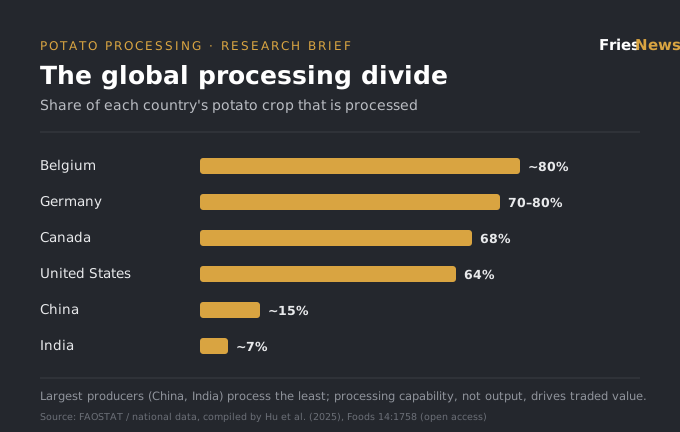
A peer-reviewed review of 11 major producing countries maps one of the defining facts of the potato economy: the world is split between nations that turn most of their crop into processed products and nations that barely process at all — and the gap is where almost all the value sits.
TakeawayThe single biggest determinant of where value accrues in the potato chain is not how many potatoes a country grows, but what share it processes — and a 2025 review shows that share ranges from roughly 7% to more than 80% across major producers.
What the study found
The review compiles production, harvest-area, processing-share and trade data for 11 major producing countries, drawn principally from FAOSTAT (to 2023) and UN Comtrade, supplemented by national agencies such as the USDA and Agriculture and Agri-Food Canada. Its central picture is a structural divide.
Developed processing economies convert the majority of their crop into fries, chips, flakes and starch. On the figures the review compiles, the United States processes about 64% of its production, Canada about 68%, Germany roughly 70–80%, and Belgium around 80%. The two largest producers by volume sit at the opposite end: India processes only about 7% of its crop, and China — the world's largest producer at roughly 93 million tonnes in 2023, against a global total near 383 million tonnes — processes only about 15%. In other words, the countries that grow the most potatoes are not the countries that turn the most potatoes into traded product.
The review's trade data (UN Comtrade, 2023) reinforce the pattern: for frozen processed potatoes, the leading exporters are Belgium, the Netherlands, Canada and the United States, while large producers such as China and South Africa appear as net importers of processed product — confirming that processing capability, not raw output, drives position in the high-value trade.
The most dynamic finding concerns China. The review reports that in 2022 China became a net exporter of frozen French fries for the first time — a shift it frames as the early sign of a possible restructuring of global frozen-fry trade, as a large, low-cost producer with rapidly expanding capacity enters export markets long dominated by North America and Europe.
The review also cites commercial market-research estimates putting the global processing market at roughly US$41 billion in 2023 and projecting about US$60 billion by 2031. These come from market-research firms rather than primary trade data, and are best read as indicative rather than authoritative (see the limits below).
