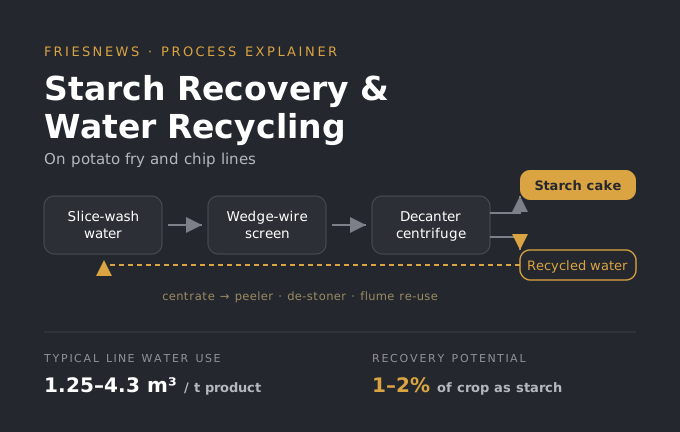
At a glance
- Line water use
- 1.25–4.3 m³/t
- Starch in slice-wash water
- 1–2% of crop
- Raw process-water COD
- ~10,000 mg/L
- Decanter cake
- ~50–60% dry
- Cake purity (vendor-stated)
- ~98%
- Recovered-starch value
- £40–140 / dry t
VITO; 2023 Belgian-processor study
Centri-Force
2023 potato-waste review
HAUS · Centri-Force · Snack Engineering
Snack Engineering, manufacturer-stated
Centri-Force
01Why it matters
The water bill behind every fry line
Potato processing is water-hungry. A line turning raw potatoes into fries or dehydrated product typically draws between 1.25 and 4.3 m³ of water per tonne of finished product, with blanching alone accounting for roughly a fifth of that — figures the Flemish institute VITO documented and that a 2023 peer-reviewed study of Belgian processors reproduced. Much of that water leaves as effluent, and it leaves dirty: raw-potato process water can run to around 10,000 mg/L of chemical oxygen demand and almost as high in total suspended solids, according to a 2023 review of potato-processing waste. The scale is easy to underestimate — that same review notes an average fries-and-dehydrate plant can generate a waste load comparable to a town of 200,000 people.
A large share of that load is starch. Every milligram of suspended starch sent down the drain is COD and BOD the plant either treats itself or pays a municipality to treat. Capturing it before it reaches the effluent system does two jobs at once: it lifts a saleable solid out of the waste stream and it lowers the strength — and cost — of what remains.
02The mechanism
Where the starch comes from
The starch is released mechanically. When a potato is sliced, diced or chipped, the knives rupture cells at the cut face and free ungelatinised starch, which is rinsed away with cold water before the product moves to the fryer. UK starch-recovery specialist Centri-Force estimates that 1–2% of every potato sliced can be recovered this way.
Timing and temperature are everything. Starch released and washed off cold stays granular and recoverable; once a potato has been blanched or otherwise heated, its starch gelatinises and can no longer be cleanly recovered, so it must be discharged as effluent. That is why recovery systems take their feed specifically from the cold-water slice washer, upstream of the blancher.
03The process
How a recovery system works
The hardware is a short, well-established chain. Starch-laden water is pumped from the slice washer to a screen — typically a parabolic wedge-wire or rotary unit — which strips out potato fines, peel fragments and foreign debris. The screened water passes to a receiving tank sized to keep the starch in suspension rather than letting it settle, and from there is metered into a decanter centrifuge.
The decanter does the separation: spinning at high speed, it throws the dense starch solids to the bowl wall, where an internal scroll conveys them out as a damp cake, while the clarified liquid — the centrate — exits separately. This screen-then-centrifuge approach mirrors the sequence described in the patent literature on potato-starch recovery, which chains screening, concentration and dewatering to pull solids out of the wash stream. Decanters from suppliers such as GEA, Alfa Laval and Flottweg are the workhorses for this dewatering step across the industry.
04The output
What comes out: starch quality and resale value
A decanter alone produces a friable cake rather than a dried powder. Independent benchmarks put the output around the 50% dry-matter mark — Turkish manufacturer HAUS cites roughly 50% dry matter off the decanter, while Centri-Force reports cake moisture below 40% (above 60% dry matter). Vendors quoting the higher end, including Snack Engineering, put their cake at 55–60% dry and around 98% pure, though every supplier stresses these figures move with potato quality.
The economics are twofold. The recovered starch is itself saleable — Centri-Force has historically valued it between £40 and £140 per dry tonne, a range it notes has swung considerably over the years — and finds a market in animal feed, food and industrial uses such as adhesives, as the recovery patents catalogue. Set against that revenue is the avoided cost of treating the starch as waste. For many processors, the second number is the larger one.
05Water reuse
Closing the water loop
Recovery systems increasingly double as water-recycling systems. The centrate leaving the centrifuge is clean enough to be stored and reused rather than discharged: routed back to upstream duties such as the peeler, de-stoner or transport flume, it displaces fresh water that would otherwise be drawn and paid for. A fresh-water top-up keeps the recycle tank supplied when reuse cannot meet demand.
The driver is partly cost and partly compliance. Belgian processors — operating under some of the tightest discharge regimes in the sector — have pushed into advanced biological nutrient removal to meet nitrogen and phosphorus limits, a 2023 study of the country's industry shows. Anything that cuts the load entering that treatment, or cuts freshwater intake at the front of the line, eases both the regulatory and the operating-cost picture.
06In practice
A worked example
Snack Engineering, based in Banbridge, Co. Down, builds one such system aimed at chip and fry lines. By the firm's own specification, it takes slice-wash water through a wedge-wire screen and into a GEA or Alfa Laval decanter at flow rates up to 9 m³/hr, with a recycle pump rated to the same throughput at 5 bar feeding reclaimed water back to peelers and de-stoners. The package is PLC-controlled via a 12-inch HMI, includes automated clean-in-place for the screen and centrifuge, monitors centrifuge vibration, and is built to ship inside a standard sea container to simplify installation. The company states its cake runs 55–60% dry and 98% pure, quality permitting.
It is one implementation of a process now common across the industry — the same screen-tank-decanter-recycle architecture, packaged. For processors weighing a system, the questions that matter are universal: the starch percentage and temperature of the feed, the dry matter and purity actually achievable on their own potatoes, the realisable resale price in their market, and the effluent cost the system offsets.
