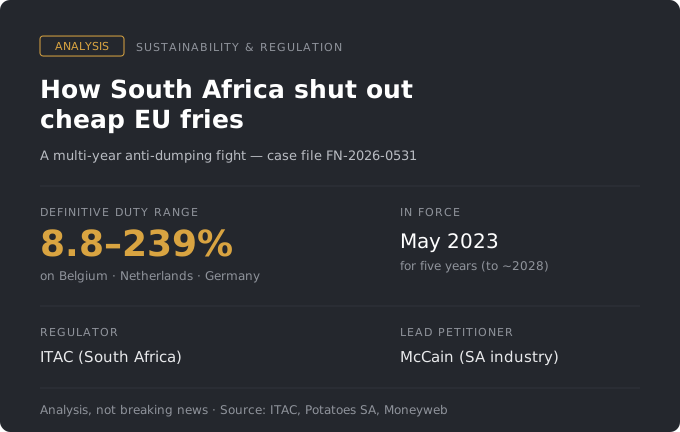
Analysis, not breaking news. This is a reference dossier on the current state of South Africa's anti-dumping regime for frozen fries. The most recent decisive development is the definitive duty determination of May 2023, which runs for five years. We will update this file if ITAC initiates a review or the measures change.
The state of play
South Africa today protects its domestic potato industry with definitive anti-dumping duties on frozen french fries imported from Belgium, the Netherlands and Germany. Imposed in May 2023 and effective for five years, the duties range from roughly 8.8% to 239% depending on exporter and country — among the steeper trade-remedy measures in the global fry trade. They are administered by the International Trade Administration Commission (ITAC) and collected by the South African Revenue Service.
For European processors — the world's largest fry exporters — this effectively closes off what had been a meaningful African market. For South African producers, it is the hard-won outcome of a fight that ran, with interruptions, for the better part of a decade.
How it got here
The story is one of protection repeatedly granted, lapsing, and being rebuilt:
Anti-dumping duties first protected the local industry from 2016. Over that period, trade remedies helped cut frozen-fry imports sharply — Potatoes SA cited a decline from roughly 46,900 tonnes in 2010 to about 18,400 tonnes in 2020, a fall of around 61%.
That first round of protection lapsed in 2021 when ITAC did not complete a "sunset review" — the process for extending duties — within the window required under WTO rules. With protection gone, imports surged: by one account, nearly 12,000 tonnes entered in just the first five months of 2021.
ITAC then self-initiated a fresh investigation, adding Germany alongside Belgium and the Netherlands, and imposed provisional duties in mid-2022 (rates running as high as ~181%). But those provisional duties lapsed again in January 2023 before the probe concluded — briefly leaving the industry exposed a second time and prompting sharp criticism.
Finally, in May 2023, ITAC issued its definitive determination: the investigation had found continued dumping causing material injury to the Southern African Customs Union (SACU) industry, and duties of 8.8%–239% were locked in for five years.
Who's on each side
The dispute pits domestic producers against importers and some trade economists.
For the duties: the local industry, led by McCain — the dominant South African producer, which had sought protection since 2019 — together with Nature's Garden and Lamberts Bay Foods, and backed by industry body Potatoes SA. Their case: below-cost European fries undercut local farmers and processors, threatening an industry that Potatoes SA valued at around R7.5 billion at the primary level and tens of thousands of jobs.
Against: importers such as Hume International, who called the rates "astronomical" amid food-price inflation, and trade advisors like XA Global Trade Advisors, who argued the duties harm consumers through "duty-upon-duty" on a staple and chiefly entrench the largest local player's dominance.
Why it matters beyond South Africa
The case is a clear example of a broader dynamic. As Europe's fry producers face oversupply and falling prices at home — and as Asian exporters undercut them in Asia and the Gulf — the pressure to place surplus volume in other markets grows. South Africa's response shows how a mid-sized producing nation can use trade remedies to wall off its market, and it is a live consideration for other African and developing-market processors weighing local capacity against cheap imports. It also sits alongside the wider 2026 story of intensifying global price competition reshaping where fries are made and sold.
Trade remedies are only one of the regulatory forces shaping the sector. On the product-safety side, the EU's acrylamide rules are another lever bearing on how — and at what cost — European fries are produced before they ever reach an export market.
Sourcing: this dossier is built on contemporaneous reporting from Daily Maverick and Moneyweb and statements from ITAC and Potatoes SA, listed in Sources. Duty rates and dates reflect the May 2023 definitive determination; figures attributed to industry bodies are quoted as their statements. This page is informational and not legal or trade advice.
