Where the world's frozen fries actually go
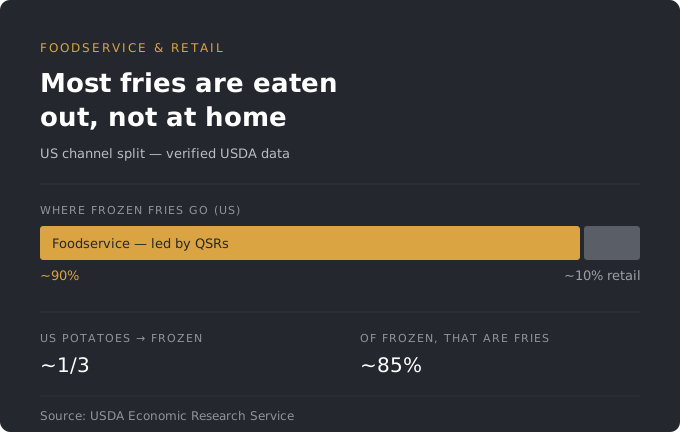
A frozen fry's destination is mostly a restaurant, not a kitchen cupboard. This is the defining fact of the demand side, and it shapes everything about how the industry sells, packages, and innovates. The data is clearest for the United States — the world's largest market — where government statistics let us see the split precisely.
According to the USDA Economic Research Service, a little more than one-third of all potatoes grown in the US are manufactured into frozen products, and about 85% of those frozen products are french fries. Crucially, only around one-tenth of frozen french fries are sold at retail (supermarkets and similar); the vast majority move through foodservice venues or export. (For the overall scale and trade flows behind this demand, see our frozen french fry market size pillar.)
Why foodservice dominates
The split isn't an accident — it reflects what frozen, par-fried fries are for. For a quick-service restaurant, a frozen fry delivers:
- Consistency — the same cut, colour and cook time across thousands of outlets;
- Speed — a par-fried product finishes in minutes;
- Low labour — no peeling, cutting, or prep;
- Long shelf life and supply reliability — frozen stock and a mature cold chain.
That package is exactly why frozen fries became the default restaurant side as the QSR industry expanded. USDA-era research found that QSRs alone accounted for about two-thirds of french-fry usage, with school cafeterias and other institutions taking a further slice, and the remainder across casual and full-service dining.
The long shift from fresh to frozen
The dominance of frozen is the result of a decades-long structural change. The share of US potatoes consumed as frozen products rose from about 27% in 1970–74 to roughly 44% in 2015–19, and frozen products — mostly fries — now make up around half of US per-capita potato availability. Fresh potatoes have steadily shrunk in the basket as processed forms grew. The same logic — convenience, processing capacity, and time-pressed consumers — is now playing out in emerging markets as QSRs and modern retail expand.
The retail channel: small but shifting
Retail is the minority channel, but it is where some of the most interesting movement is. Two forces stand out:
Air-fryers. Widespread home air-fryer adoption has narrowed the gap between a supermarket bag of fries and a restaurant serving, supporting growth in retail demand and prompting producers to engineer air-fryer-optimised formats.
Private label and premiumisation. Supermarket own-brands and premium/flavoured retail lines (seasoned, coated, sweet-potato, specialty cuts) are expanding the category beyond the plain straight-cut bag.
Delivery is reshaping the foodservice side
On the foodservice side, the rise of online food delivery has made fries an even higher-frequency item — a near-automatic add-on to delivered meals, lifting order frequency and repeat consumption. But delivery also exposes the fry's biggest weakness, holding time: a fry that's soggy by the time it arrives is a problem. That single pressure is driving much of the product innovation in coatings designed to keep fries crisp in transit — a direct line from a consumer-behaviour shift to a processing decision.
What it means for the industry
The channel mix is the strategic backdrop for the whole sector. Because demand is foodservice-led, the industry's fortunes track QSR expansion, foodservice recovery, and the big chains' sourcing decisions — and the major processors that supply them — far more than supermarket trends. But the retail and delivery edges are where consumer-facing innovation — air-fryer formats, coatings, premium lines — is concentrated. A producer's positioning across these channels, and how it responds to delivery and air-frying, increasingly defines where it competes.
Methodology: the foodservice/retail split, QSR share, and consumption-trend figures are drawn from USDA Economic Research Service data, listed in Sources. Some figures reflect the most recent multi-year USDA windows available rather than a single current year. Channel and behavioural trends (delivery, air-fryers, private label) are described qualitatively where precise current-year figures could not be confirmed against a primary source.
