How large is the frozen french fry market?
There is no official dollar figure for the global frozen french fry market. Any source that gives you one precise number is quoting a single firm's model. What exists instead is two kinds of evidence, and this page keeps them apart:
- Official data in tonnes and trade value, from trade bodies and governments. This is fact.
- Commercial estimates of market value, from research firms that sell reports. These are estimates, and they disagree.
- $15.9–25.7bn
- Frozen-fry-only estimates, 2024–25 (see table)
- 1.6×
- Spread between low and high frozen-fry estimate
- 7.5M t
- EU fries & potato products output (EUPPA)
- €8.9bn
- EU27 processed-potato exports, 2024
The range of estimates, side by side
These are every recent estimate we could trace to the firm's own page or press release. Each is that firm's modelled figure, not a measured market size. Read the scope column before comparing numbers: firms size different things.
| Firm | Scope as stated | Base-year value | Forecast | CAGR |
|---|---|---|---|---|
| Market Research Future | Frozen french fries | US$15.86bn (2024) | US$22.85bn (2035) | 3.37% |
| Technavio | Frozen potato fries — white-potato segment only | US$15.69bn (2024) | +US$8.08bn over 2026–30 | 5.5% |
| Fact.MR | Frozen french fries | US$25.7bn (2025) | US$39.9bn (2035) | 4.5% |
| Fortune Business Insights | All french fries (frozen ~83%) | US$17.94bn (2025) | US$29.98bn (2034) | 5.95% |
| The Business Research Co. | French fries, fresh and frozen | US$18.44bn (2025) | US$24.87bn (2030) | 6.4% |
| Mordor Intelligence | All french fries (frozen ~88%) | US$24.32bn (2025) | US$33.10bn (2031) | 5.41% |
| Expert Market Research | All frozen potato products (fries, hash browns, wedges, etc.) | US$72.81bn (2025) | US$119.73bn (2035) | 5.10% |
Why the estimates differ
Scope
What is being counted
Frozen fries only (MRFR, Fact.MR, Technavio), all french fries including fresh and chilled (Mordor, Fortune, TBRC), or every frozen potato product (Expert Market Research, about US$73bn). The broadest scope is roughly three times the narrowest.
Valuation point
Whose price
Firms rarely say whether they value manufacturer sales or what restaurants and shoppers spend. A foodservice-weighted model (Fortune: ~60% foodservice) and a retail-weighted one (Mordor: ~75% household/retail) cannot be compared directly.
Base year and currency
When, in what money
Base years run from 2024 to 2026 and forecasts end anywhere from 2030 to 2035. Dollar values also move with EUR/USD and CAD/USD, since most production is invoiced in euros or Canadian dollars.
Method
How it was built
These are top-down models in paid reports with undisclosed methods. None is built up from customs or production statistics, which is why we treat them as estimates and anchor them in official data below.
The official anchors
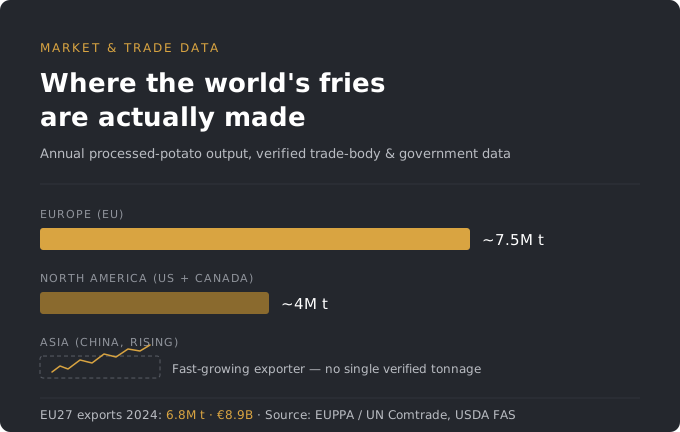
Europe is the largest producing and exporting region, and its sector is well documented. The European Potato Processors' Association (EUPPA), whose members account for more than 90% of Europe's processed-potato production, reports 51 processing facilities producing about 7.5 million tonnes a year. EU27 exports of processed potato products reached 6.8 million tonnes worth €8.9 billion in 2024, including intra-EU trade; about 3 million tonnes (€4.0 billion) went outside the EU. Belgium, France, Germany, the Netherlands and Poland accounted for 98.2% of that export value.
Country trade data (UN Comtrade, HS 200410, frozen prepared potatoes, 2024) shows the leaders directly: Belgium exported US$3.71 billion (2.75 million tonnes), the Netherlands US$2.71 billion, Canada US$2.07 billion and the United States US$1.54 billion. The full rankings, including importers, are in top frozen french fry exporting and importing countries.
North America. US processors used 163 million cwt (about 7.4 million tonnes) of raw potatoes for frozen french fries and other frozen products from the 2024 crop, down 7% from 2023 (USDA NASS). Canada exported C$2.71 billion (1.40 million tonnes) of frozen potatoes in the 2024–25 crop year, 90% of it to the US, and about 69% of its 2024 crop went to processing (Agriculture and Agri-Food Canada). The companies behind this output are profiled in leading frozen french fry manufacturers.
Asia is the fastest-changing region. USDA's Foreign Agricultural Service reported that China became a net exporter of frozen fries in the 2021/22 marketing year, and UN Comtrade data show Chinese exports of 206,138 tonnes in 2024.
A note on scale
Official figures are in tonnes, trade value or raw-potato use, not "market size". They cannot be added up into a global dollar figure without double counting (EU exports include intra-EU trade, for example). That gap is exactly what the commercial estimates try to fill, and why they vary.
The verifiable bottom line
In volume and trade terms, the frozen french fry trade is large, concentrated among a handful of European and North American exporters, and seeing new supply from Asia and Egypt. The dollar market size quoted elsewhere is a modelled estimate: frozen-fry-only figures run from about US$16 billion to US$26 billion for 2024–25. Cite the range with its scope, or cite the official data. We will update this page as primary sources publish new figures. (For who actually eats these fries, see frozen fries in foodservice & retail.)
Methodology: official figures come from EUPPA, UN Comtrade (via World Bank WITS), USDA NASS, USDA FAS and Agriculture and Agri-Food Canada, each dated in Sources. Commercial market-value estimates are shown only as attributed estimates, with scope, base year and publication date as stated on each firm's page or press release, per the FriesNews editorial sourcing policy (approved for citation as a labelled range). We excluded figures that appear only on unattributed aggregator sites. Unit conversion: 1 cwt = 45.36 kg.
