Who exports and imports the most frozen french fries?
The frozen french fry trade is one of the more concentrated in global food: a small group of countries supply most of the world, and a similarly small group buys most of it. Because this is trade, the firmest data is in volumes and values reported by trade bodies and customs authorities — which is what this page is built on. Where only commercial estimates exist, we say so rather than presenting them as fact.
The headline picture: Europe leads exports, North America is the other major supplier, the US/UK/Japan/Gulf lead imports, and China is the fastest-rising new exporter.
The 2024 numbers: official trade data
The table below uses UN Comtrade data for HS 200410 (potatoes prepared or preserved, frozen), the customs code that covers frozen french fries along with smaller volumes of other frozen potato products. Values are gross exports and imports in US dollars, as published by the World Bank's WITS.
| Exporter | Exports 2024 (tonnes) | Value (US$) |
|---|---|---|
| Belgium | 2,752,580 | $3.71bn |
| Netherlands | 1,798,230 | $2.71bn |
| Canada | 1,446,130 | $2.07bn |
| United States | 916,316 | $1.54bn |
| France | 635,167 | $881m |
| Germany | 316,712 | $455m |
| Poland | 221,452 | $310m |
| Argentina | 186,692 | $294m |
| China | 206,138 | $260m |
| Egypt | 150,364 | $210m |
| India | 172,414 | $203m |
| Importer | Imports 2024 (tonnes) | Value (US$) |
|---|---|---|
| United States | 1,525,600 | $2.33bn |
| United Kingdom | not reported | $1.42bn |
| France | 673,652 | $944m |
| Japan | 398,050 | $714m |
| Germany | 413,764 | $611m |
| Mexico | 311,364 | $500m |
| Italy | 286,817 | $498m |
| Saudi Arabia | 308,753 | $471m |
| Brazil | 323,764 | $466m |
| Netherlands | 342,632 | $391m |
Two things stand out. First, the European figures include heavy intra-EU trade: France is both a top-five exporter and the third-largest importer, reflecting the cross-border flow between French potato supply and Belgian and Dutch plants. Second, the United States imports more than it exports by value despite being a major producer; Canada is its main supplier.
The leading exporters
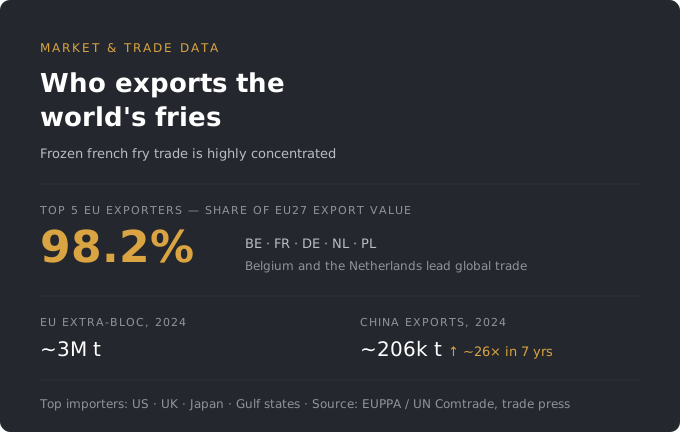
The European Union is the world's largest exporter of frozen french fries and processed potato products. According to the European Potato Processors' Association (EUPPA), five countries — Belgium, France, Germany, the Netherlands and Poland — accounted for 98.2% of total EU27 processed-potato export value in 2024. Belgium and the Netherlands are the standout pair, long described across the industry as the dominant force in global frozen fry trade. EU exports to destinations outside the bloc came to roughly 3 million tonnes in 2024.
North America is the second major exporting bloc. Combined US and Canadian frozen potato production was about 4 million tonnes in 2024, and both countries are significant offshore exporters — though North American fryers have been losing global market share in recent years as exports softened. Canada in particular set record french-fry export volumes in late 2025.
China is the fastest-rising exporter. UN Comtrade data show it exported 206,138 tonnes in 2024, ranking tenth by value. Chinese customs data reported by EastFruit put that at nearly 26-fold growth over seven years, with Japan, the Philippines, Thailand and Indonesia as key destinations. India has followed a similar path from importer to exporter. This Asian expansion is steadily eroding the share that European and North American suppliers once held in Asia-Pacific and Middle Eastern markets.
The leading importers
The biggest buyers are a mix of mature Western markets and fast-growing emerging ones.
Japan has historically been the single largest external customer for EU french fries — taking around 590 million pounds in the year ending January 2024, even after a year-on-year cut. Mexico, Brazil, the United Kingdom, and the United States are all major importers; notably, the US is itself both a large producer and a large importer of EU fries, increasing its EU purchases by about 7% in that period.
The Gulf states — especially Saudi Arabia and the UAE — are a critical and growing destination, supplied heavily by Belgium and the Netherlands.
Trade is not static
A useful illustration of how quickly flows shift: in the year ending January 2024, global french fry exports fell about 4.6% — only the second annual decline in 20 years (the other being the 2020–21 pandemic year). Six of the EU's top 10 external customers cut purchases, with the largest reductions in Brazil, Colombia and Saudi Arabia, while Australia sharply increased imports.
Prices move trade too: competitive Asian supply, freight costs, currency, and shipping disruptions together help determine who buys from whom in any given year. Japan is a live example: its imports hit a record in the year to April 2026 while the US lead narrowed (Japan's frozen-fry imports hit a record). For the structural picture behind these shifts — which producing countries actually process their crop — see the global processing divide.
A note on dollar-value rankings
You will also see frozen-fry import rankings by dollar value — the United States, United Kingdom, and Japan typically topping such lists. These come largely from commercial market-intelligence platforms whose underlying methods aren't disclosed, so we treat them as indicative rather than authoritative, and lead instead with the volume and trade-body data above. Where we cite a dollar ranking, it is attributed to its source as an estimate. We unpack these dollar valuations — and why different firms' estimates differ by billions — in our companion pillar on the frozen french fry market size.
The verifiable bottom line
In volume terms, the frozen french fry trade runs along a clear spine: the EU (above all Belgium and the Netherlands) and North America supply the world; the US, UK, Japan, and the Gulf are the anchor buyers; and China and India are rewriting the Asian map from the supply side. Flows shift year to year with harvests, prices, freight, and geopolitics — and we will update this page as trade bodies and customs authorities publish new figures.
Methodology: country rankings use UN Comtrade data for HS 200410 as published by the World Bank's WITS (2024, accessed September 2026). Other figures are drawn from EUPPA (trade-body data) and named trade-press reporting of official trade and customs statistics, each dated in the Sources list. Dollar-value rankings from commercial platforms are presented as labelled estimates, not as established fact, per the FriesNews editorial sourcing policy.
