How frozen french fries are made
Almost every french fry served in a restaurant, and every bag in the freezer aisle, starts life on an industrial line. The product that comes off that line is not a finished fry: it is a par-cooked, quick-frozen strip, engineered so the final cooking happens later, in the restaurant or your kitchen. Understanding the steps explains why a good frozen fry has a crisp crust and a fluffy core, and why a bad one turns soggy or grey.
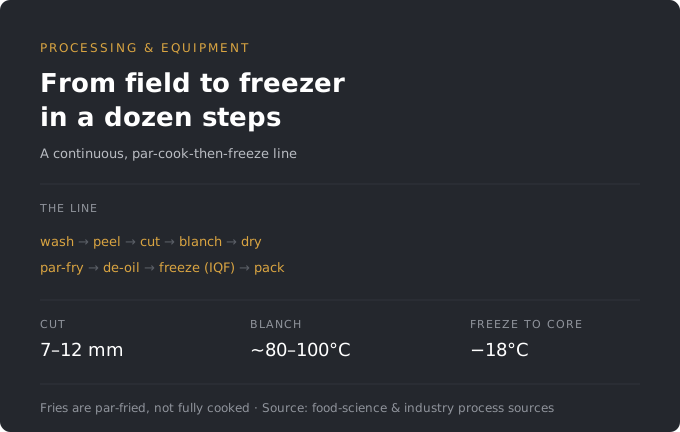
The process is a sequence of controlled heat-and-moisture treatments.
- 1
Wash and sort
Potatoes are washed and graded. Undersized, green or damaged tubers are removed so only good raw material goes on.
- 2
Peel
Skins are removed, usually with steam peelers, and remaining eyes and defects are trimmed.
- 3
Cut
Knife systems or high-pressure water knives cut the potatoes into strips of a set cross-section. Slivers and short pieces are removed.
- 4
Blanch
Strips are heated in hot water or steam to inactivate browning enzymes and leach out sugars for even colour and lower acrylamide.
- 5
Treat and dry
A dip can add dextrose for colour control and sodium acid pyrophosphate to stop darkening. Surface water is then removed so the oil stays hot.
- 6
Par-fry
A brief fry sets the crust and colour. Lamb Weston says its fries are fried at 180°C for around a minute.
- 7
Freeze
Fries go straight into a freezing tunnel and are frozen individually, then kept at −18°C or colder.
- 8
Pack
Frozen fries are packed after freezing, so the pieces stay separate and pour freely.
The raw material
It begins with the right potato. Manufacturers favour large, oblong, high-dry-matter varieties (Russet Burbank is the classic), because high starch and low moisture produce the fluffy interior and crisp surface that define a quality fry. Long tubers also yield more full-length strips. See potato varieties for frozen fries for how processors choose.
Step by step
1. Washing and sorting. Potatoes are washed and passed through sorting equipment that removes undersized, green or bruised tubers. Modern lines use AI optical sorting here and again after cutting.
2. Peeling. Skins are removed, typically by steam peelers (a burst of high-pressure steam loosens the skin) or abrasion peelers, balancing clean removal against potato loss. Residual eyes and green spots are trimmed.
3. Cutting. Peeled potatoes are pushed through knife systems or high-pressure water knives into strips. The cross-section defines the product: shoestring, regular or steak cut. Off-spec, short or discoloured pieces are removed; EU acrylamide rules specifically require removing slivers, which brown faster. Cutting is also where the other frozen potato product types, such as crinkle and waffle fries, wedges and hash browns, diverge from the straight-cut fry.
4. Blanching. The strips are heated in hot water or steam. This is one of the most important quality steps. It inactivates the enzymes that cause browning, which a 2024 Wageningen review of industrial fry texture places at 80–100°C. It also leaches out reducing sugars, which evens out colour and lowers acrylamide formation (EU Regulation 2017/2158 lists blanching for this purpose), and it starts softening the potato's cell structure.
5. Treatment and drying. After blanching, producers may add dextrose in a controlled way so every batch reaches the same colour, and sodium acid pyrophosphate (disodium diphosphate, E450) to prevent the grey after-cooking darkening that some potatoes show. The EU acrylamide rules explain both: controlled dextrose after blanching gives a lower acrylamide level at the same colour than the potato's own sugars would. Surface moisture is then removed, because excess water would drop the oil temperature at the next step and produce soggy, oily fries.
6. Par-frying. The strips are partially fried in vegetable oil. Lamb Weston says its fries are fried at 180°C for around a minute before going straight to freezing. This brief fry sets the surface crust, develops colour and dehydrates the surface. Critically, it does not fully cook the fry: the interior stays soft, leaving the final cook to the restaurant or home kitchen.
7. Freezing. The par-fried fries go immediately into a freezing tunnel, where they are frozen individually (individual quick freezing, IQF). Fast freezing forms small ice crystals that preserve texture. Under EU rules, quick-frozen foods must then be kept at −18°C or colder throughout storage and distribution.
8. Packing. Finally the frozen fries are packed. Freezing happens before packing so the individual fries don't stick together and the bag pours freely.
Are frozen fries fried, pre-cooked, or ready to eat?
They are fried, but not fully cooked. The factory par-fry builds the crust and colour and removes moisture; the final cook finishes the interior and crisps the outside. That is why manufacturers say frozen fries are not ready to eat. McCain's US FAQ states its products are not pre-cooked and should not be eaten straight from the bag or while frozen, and its packs carry the instruction to cook fully from frozen.
Cook from frozen
Pack instructions are the reference for final cooking. As one example, McCain's Classic Cut fries (US) list deep-frying at 350°F (177°C) for 3–3.5 minutes, oven-baking at 425°F (218°C) for 24–28 minutes, or air-frying at 360°F (182°C) for 12–13 minutes. In the EU, fry producers must advise frying at 160–175°C, or oven-baking at 180–220°C, to keep acrylamide low.
This two-stage model is what lets a frozen fry ship and store for months, yet finish into something close to fresh-fried in minutes. It also explains a detail on packaging: products intended for deep-frying, oven-baking or air-frying are formulated differently, because each final-cooking method removes moisture differently.
What goes into the bag, and how much oil?
The ingredient list is short. A typical US retail fry (McCain Classic Cut) lists potatoes, vegetable oil, and 2% or less of annatto and caramel colour, salt and sodium acid pyrophosphate "added to maintain color". Some products also list dextrose, and coated fries add a thin batter.
Because the par-fry is brief, frozen fries carry less fat than many people assume. USDA FoodData Central lists frozen fries as purchased at 4.66 g of fat per 100 g, and 5.22 g after oven-heating (the small rise mostly reflects water loss). Fast-food fries deep-fried in vegetable oil are listed at 14.7 g per 100 g.
| Product (USDA FoodData Central) | FDC ID | Fat, g per 100 g |
|---|---|---|
| French fries, frozen, as purchased (salt not added) | 170523 | 4.66 |
| Same, oven-heated | 170118 | 5.22 |
| Fast food, french fried in vegetable oil | 170698 | 14.7 |
How much fry comes from a potato?
A peer-reviewed US life-cycle model (Parajuli et al., 2021) puts frozen-fry output at about 61% of the raw potato weight received at the processing plant, or roughly 1.6 kg of raw potatoes per kilogram of frozen fries. Other studies measure recovery lower, around half, depending on variety, dry matter and where losses are counted. We compare those figures in how much french fries are worth from 1 kg of potatoes.
Why the engineering matters
Every step is a lever on starch, moisture and texture. Variety sets the starch baseline; blanching tunes colour and structure; drying and par-frying control moisture and crust; fast freezing protects what was built upstream. A fault at any stage, such as too much surface water before frying, slow freezing or the wrong variety, shows up as a soggy, greasy or grey fry.
TakeawayThe industrial process exists to make that outcome consistent across millions of tonnes a year.
Methodology: this explainer describes the standard industrial method. Process parameters come from a producer's published process description (Lamb Weston EMEA), EU legislation (Regulation 2017/2158; Directive 89/108/EEC), a peer-reviewed review (van der Sman & Schenk, 2024) and a peer-reviewed life-cycle model (Parajuli et al., 2021); nutrition figures come from USDA FoodData Central. Exact settings vary by producer, product and final-cooking method, and most producers do not publish blanching times, so we do not state one.
