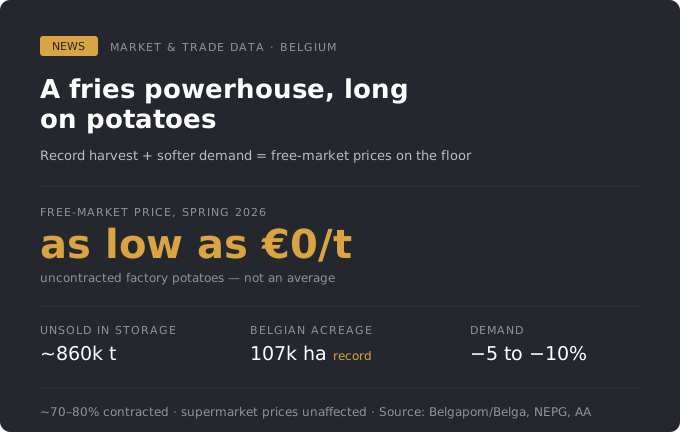
The world's largest frozen-fry exporter has a problem most years would envy and this year cannot absorb: too many potatoes. In Belgium, the free-market price for factory potatoes — the raw material of the country's vast fries industry — has fallen to as low as €0 a tonne in spring 2026, a level the trade body Belgapom describes as part of an unprecedented surplus.
"Oversupply happens every few years, but this crisis is unprecedented," a potato expert at the General Farmers' Syndicate told Belgian broadcaster VRT. By one widely-cited account, around 860,000 tonnes of unsold potatoes are sitting in long-term storage — with the next harvest only weeks away.
How a fries powerhouse ended up long on potatoes
The surplus is the flip side of success. As Belgium's fries industry expanded, processors built closer ties with growers and farmers planted more — pushing potato acreage to a record ~107,000 hectares, up from roughly 95,000 a few years ago. Supply rose into the expectation of ever-growing demand.
Then demand softened. Agricultural experts put the drop at roughly 5–10%, and Belgapom's chief executive has said that for about a year there has been no demand for potatoes beyond what processors had already contracted. As he put it, the factories are "sufficiently covered." With no buyers for the extra volume, the price of uncontracted potatoes fell through the floor — in some recent weeks, no price was set at all because no trades occurred.
Why your supermarket bag won't get cheaper
The headline "€0 potatoes" is real but narrow, and the distinction matters. The collapse applies to free-market factory potatoes destined for industrial frozen-fry processing — not the table potatoes you buy to cook at home, which move through a separate supply chain with different varieties, quality standards, and pricing. Those remain comparatively expensive and are not part of the glut.
It's also a minority of the crop. Between 70% and 80% of the processing harvest was sold under contract months ago at higher fixed prices, cushioning many growers. The pain is concentrated among those holding uncontracted stock on the open market — a two-speed outcome where contract coverage, not the average price, determines who is in trouble. Retail prices, accordingly, are not expected to fall.
A regional, not just Belgian, squeeze
Belgium is the sharpest case, but not the only one. The North-Western European Potato Growers (NEPG) — covering Belgium, the Netherlands, Germany and France — has warned of overproduction for months, pointing to a harvest around 10% higher than the prior year set against declining processor demand. Surplus options are thin: diverting potatoes to animal feed or biofuel can soak up only a fraction of the volume. For the zone-wide view, see EU-04 swings from glut to acreage cuts for 2026/27.
The strategic backdrop
There is a longer game underneath the spot prices. When Europe is long on potatoes, buyers gain leverage and downside-free reasons to trial alternative origins — exactly the conditions under which global market share can drift over time, as lower-cost suppliers in Asia and elsewhere scale up. A surplus year is uncomfortable for European growers in the moment; it can also be the moment competitors use to win a foothold.
TakeawayFor a sector whose strength is its scale and reliability, defending consistency through the glut — rather than chasing the bottom on price — is the harder, more important task.
Sourcing: figures are drawn from the Belgian trade body Belgapom (via Belga News Agency), grower-association NEPG, and Anadolu Agency reporting, listed in Sources. The €0 figure refers to free-market (uncontracted) factory potatoes at specific spring-2026 quotations and is not an average across the contracted crop. Some volume figures (e.g. ~860,000 tonnes) trace to Belgian broadcaster VRT as reported in the press.
